> For the complete documentation index, see [llms.txt](https://docs.carto.com/llms.txt). Markdown versions of documentation pages are available by appending `.md` to page URLs; this page is available as [Markdown](https://docs.carto.com/carto-user-manual/workflows/using-variables-in-workflows.md).
# Using variables in workflows
### Creating variables
In order to start using variables, click on the three dots in the upper-right corner and find 'Variables'.
* **Order:** The order of the variables is relevant when setting them as parameters, as they will be used as inputs for the generated stored procedure in that order, defining the procedure's signature.
* **Name:** Give a name to the variable. This name will be referenced as @name within an expression.
{% hint style="warning" %}
Using a variable name that conflicts with a column name can produce errors on the Workflow's SQL code. Please make sure that your variable's name is not the same as any of the column names in the data sources involved in the Workflow.
{% endhint %}
* **Type:** Number, String, and Geo variables are supported.
* **Number** and **String** variables accept numeric and text values respectively.
* **Geo** variables hold a GeoJSON FeatureCollection value. The value is created using a point-and-click drawing UI, similar to the [Draw Custom Features](/carto-user-manual/workflows/components/parsers.md#draw-custom-features) component. Geo variables can be referenced in expressions as `{{@geo_var_name}}` to pass geographic features to compatible components. When used via [API](/carto-user-manual/workflows/executing-workflows-via-api.md) or [MCP Tools](/carto-user-manual/workflows/workflows-as-mcp-tools.md), the value is passed as a JSON string (e.g. `{"type":"FeatureCollection","features":[...]}`).
* **Default value:** The default value for the variable. When executing a workflow from the UI, this is the value that will be given to the variable.
* **Parameter scope:** Mark a variable as a parameter to allow external access to it. A variable can have one or more of the following scopes:
* **API**: Makes the variable a parameter for [API execution](/carto-user-manual/workflows/executing-workflows-via-api.md).
* **MCP Tool**: Makes the variable a parameter for [MCP Tool execution](/carto-user-manual/workflows/workflows-as-mcp-tools.md).
* **Viewer**: Makes the variable a parameter visible in [Viewer Mode](/carto-user-manual/workflows/viewer-mode.md). When the Viewer scope is enabled, you can also configure:
* **Display name**: The label shown to viewers (defaults to a formatted version of the variable name).
* **Helper text** (optional): A short description to guide viewers (max 140 characters).
{% hint style="success" %}
Learn more about executing parameterized workflows in [**this section**](/carto-user-manual/workflows/executing-workflows-via-api.md), or about sharing workflows with viewers in [**Viewer Mode**](/carto-user-manual/workflows/viewer-mode.md).
{% endhint %}
Click on the '+' button to confirm the creation of the variable. A new entry will appear where you can keep adding variables.
### Using variables and expressions in components
Once a variable has been defined, you can use them to control the value of a component's settings. As global variables, they can be used in one or many occasions within the same workflow, and they will apply the same value to the setting where they're used.
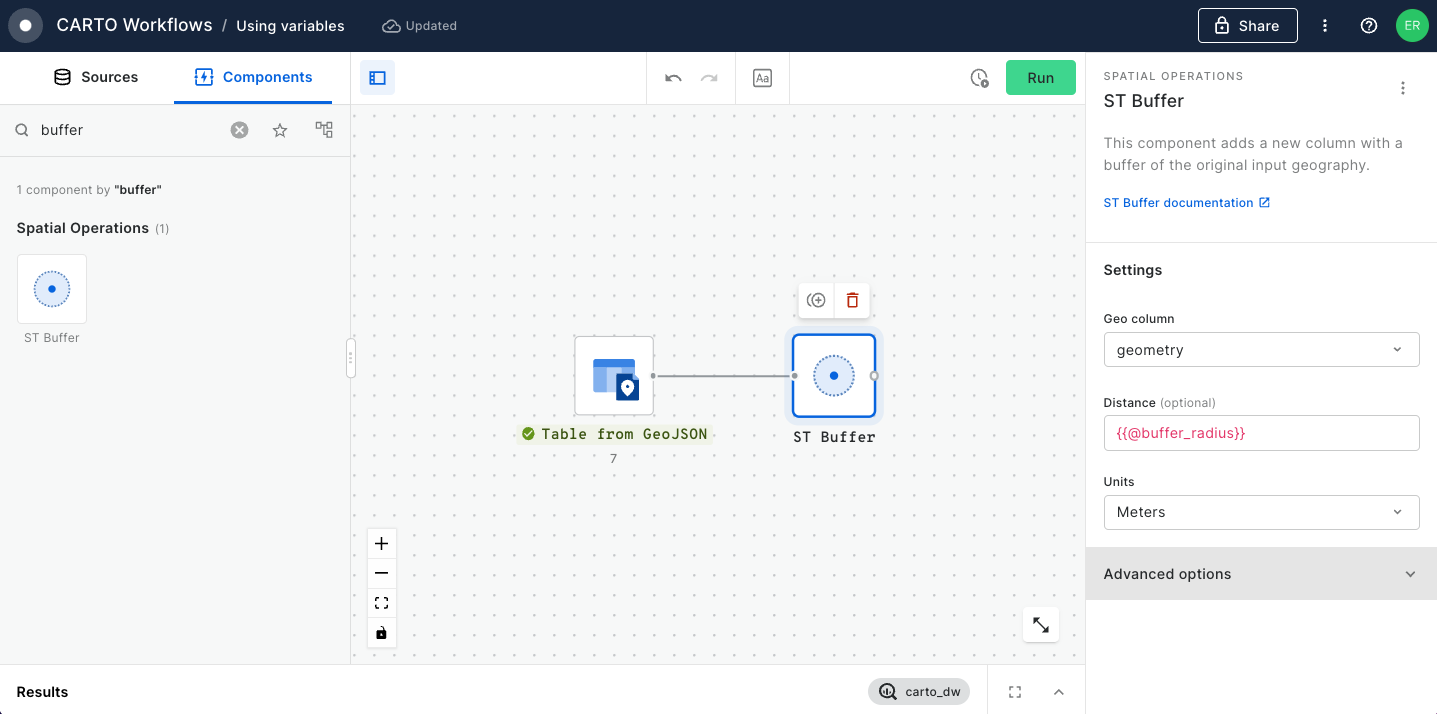
To use a variable in a setting, just start typing `{{@variable_name}}` and the available matching variables will appear. Make sure that you close the variable name with double curly braces, as shown in the screenshot below.
Not only variables, but expressions including SQL operations and column names are also allowed, so something like this could be used as a setting on a node: `{{@buffer_radius / distance * 10}}` which combines a **parameter** (`buffer_radius`) with a **column** (`distance`) in a mathematical operation.
{% hint style="info" %}
When using [custom components](/carto-user-manual/workflows/components/custom.md), include only `@variable_name` without curly braces.
{% endhint %}
---
# Agent Instructions
This documentation is published with GitBook. GitBook is the documentation platform designed so that both humans and AI agents can read, navigate, and reason over technical content effectively. Learn more at gitbook.com.
## Querying This Documentation
If you need additional information that is not directly available in this page, you can query the documentation by asking a question.
Perform an HTTP GET request on the following URL with the `ask` and `goal` query parameters:
```
GET https://docs.carto.com/carto-user-manual/workflows/using-variables-in-workflows.md?ask=&goal=
```
`ask` is the immediate question: it should be specific, self-contained, and written in natural language.
`goal` is what the user is ultimately trying to achieve, the reason they need the answer. Sharing it helps GitBook give you a better, more relevant answer. A goal is most helpful when it describes the outcome the user wants rather than restating the question. For example, with `ask=how do I create an API token`, a goal like `automate deployments from our CI pipeline` lets GitBook tailor the answer to that use case.
The response will contain a direct answer to the question and relevant excerpts and sources from the documentation.
Use this mechanism when the answer is not explicitly present in the current page, you need clarification or additional context, or you want to retrieve related documentation sections.