> For the complete documentation index, see [llms.txt](https://docs.carto.com/llms.txt). Markdown versions of documentation pages are available by appending `.md` to page URLs; this page is available as [Markdown](https://docs.carto.com/carto-user-manual/maps/widgets/table-widget.md).
# Table widget
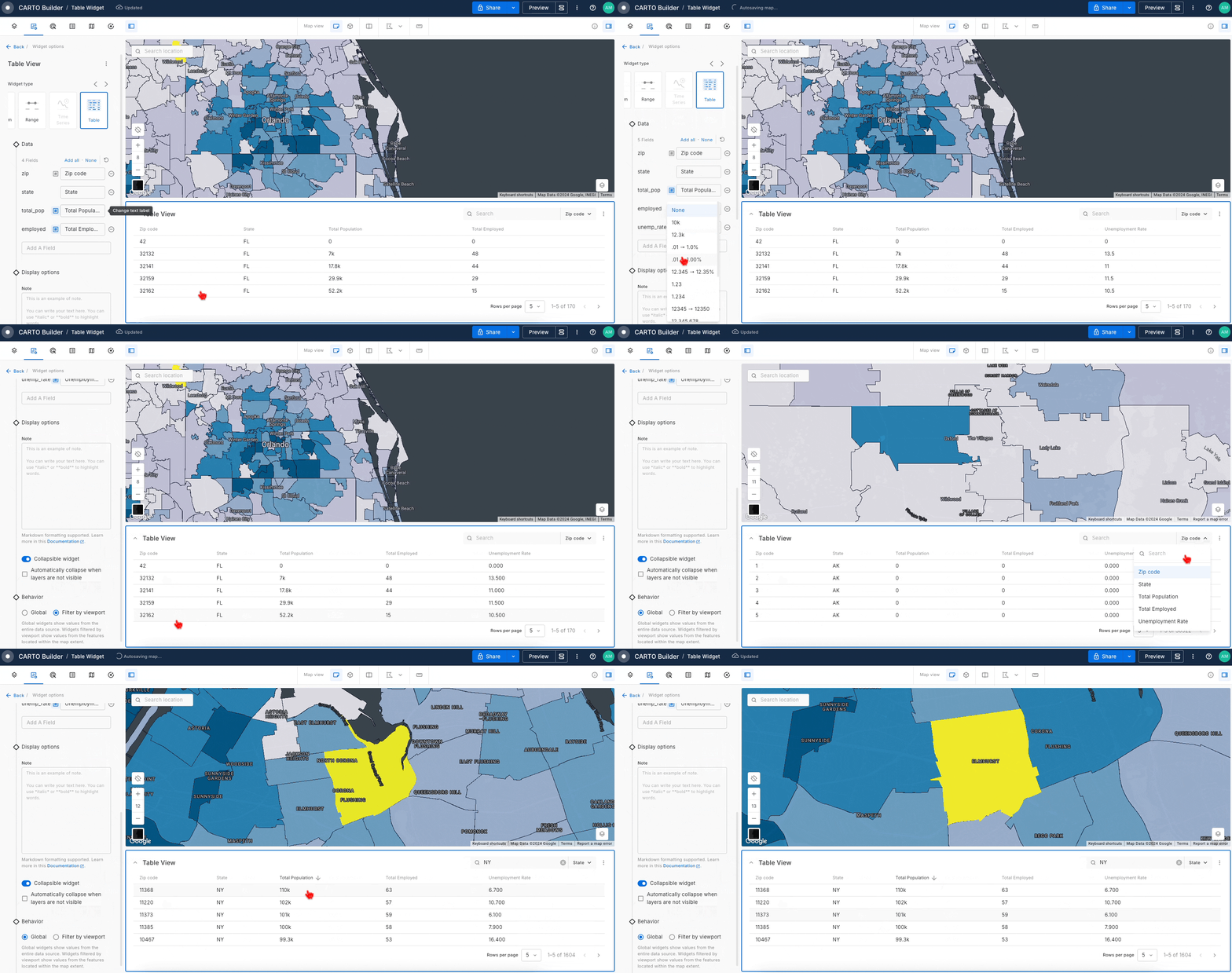
The Table Widget offers a clear, structured view of your dataset, enabling easy data exploration. You can **search**, **highlight** features by hovering, and **zoom** to specific features by clicking, all while seamlessly connecting the table to the map.
### Widget Data
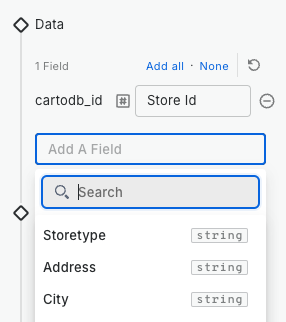
In the Data section, you can specify which properties to display in the Table view, allowing you to set labels and customizing the format as needed.
### Widget Display
The Display section allows you to add notes that support [Markdown syntax](https://www.markdownguide.org/basic-syntax/) for better clarity and customization. Within the widget, you can choose the number of rows displayed per page and use pagination to view additional data. Sorting can be applied to the columns in either ascending or descending order.
The Table widget sits at the bottom of the map and has its own collapse control. You can keep the table open while the widgets panel is hidden, and the other way around.
### Widget behavior
n the Behavior section, you can choose between two modes:
* **Viewport Mode**: Shows only features visible in the current map view. Both displayed data and search are limited to features within the viewport.
* **Global Mode**: Displays all features from the data source, allowing you to search and zoom to any feature, even if it’s outside the current map view.
{% hint style="info" %}
If a **mask** is applied using the Selection tool, this will override both the Global and Viewport modes. In this case, both the displayed data and search results will be limited to the features within the mask's extent.
{% endhint %}
Learn more about widget behavior [here](/carto-user-manual/maps/widgets.md#widget-behaviour).
---
# Agent Instructions
This documentation is published with GitBook. GitBook is the documentation platform designed so that both humans and AI agents can read, navigate, and reason over technical content effectively. Learn more at gitbook.com.
## Querying This Documentation
If you need additional information that is not directly available in this page, you can query the documentation by asking a question.
Perform an HTTP GET request on the following URL with the `ask` and `goal` query parameters:
```
GET https://docs.carto.com/carto-user-manual/maps/widgets/table-widget.md?ask=&goal=
```
`ask` is the immediate question: it should be specific, self-contained, and written in natural language.
`goal` is what the user is ultimately trying to achieve, the reason they need the answer. Sharing it helps GitBook give you a better, more relevant answer. A goal is most helpful when it describes the outcome the user wants rather than restating the question. For example, with `ask=how do I create an API token`, a goal like `automate deployments from our CI pipeline` lets GitBook tailor the answer to that use case.
The response will contain a direct answer to the question and relevant excerpts and sources from the documentation.
Use this mechanism when the answer is not explicitly present in the current page, you need clarification or additional context, or you want to retrieve related documentation sections.