> For the complete documentation index, see [llms.txt](https://docs.carto.com/llms.txt). Markdown versions of documentation pages are available by appending `.md` to page URLs; this page is available as [Markdown](https://docs.carto.com/carto-user-manual/workflows/managing-maps.md).
# Managing workflows
You will be able to manage workflows from the Workflows section of the workspace. From there, you will be able to:
* Edit workflow names
* Create and apply tags to workflows
* Share workflows
* Duplicate workflows
* Delete workflows
These options may be restricted depending on the user's role and permissions.
### Organizing workflows into projects and folders
You can group workflows into [projects and folders](/carto-user-manual/projects.md) to keep your Workflows section organized and to share related workflows together. Move a workflow into a project or folder from its card menu, or add a shortcut to it from another project.
### Grid and list views
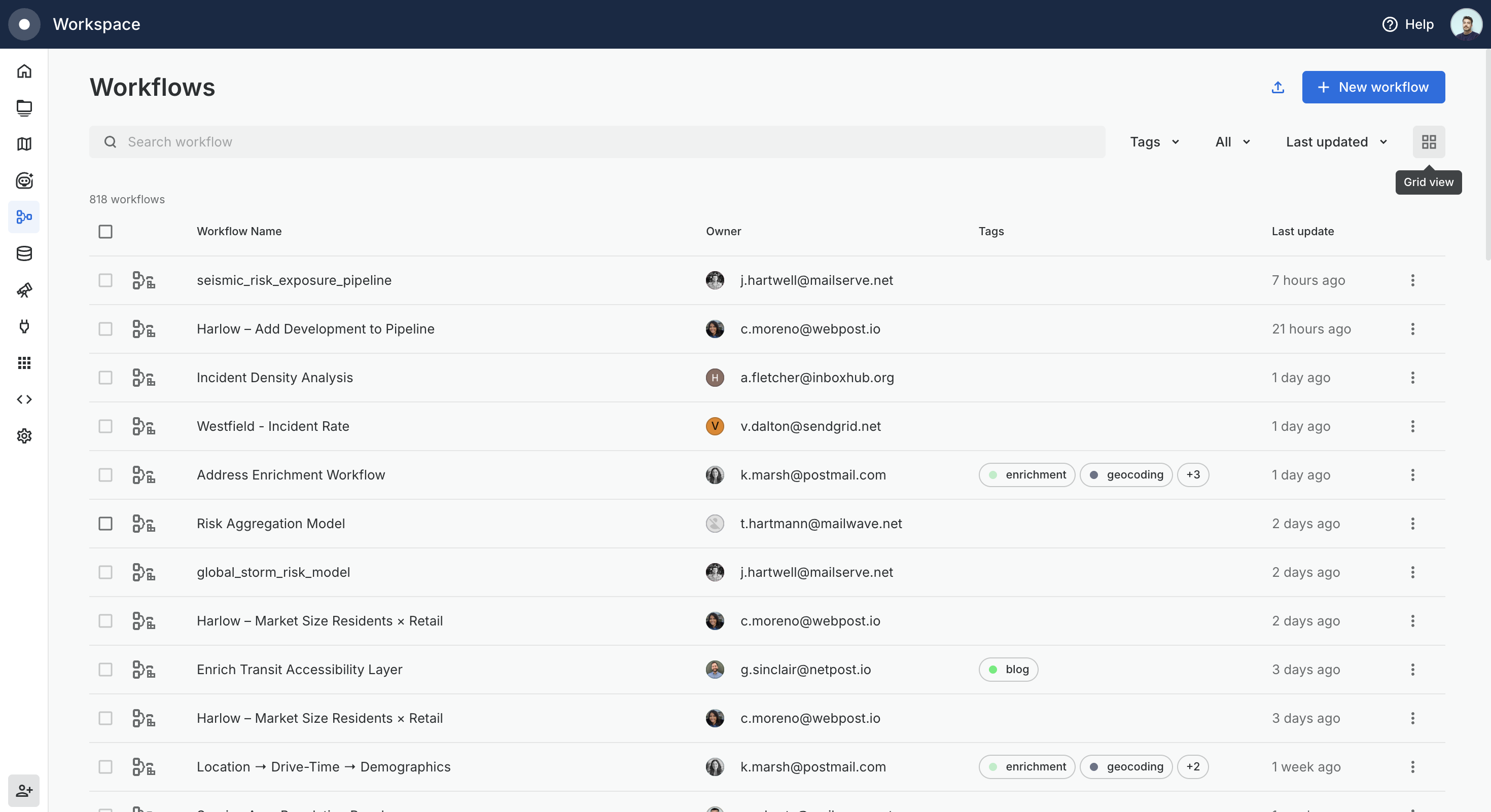
The Workflows section can be shown as cards (grid) or as a list, using the grid/list toggle at the top right.
The Workflows section in list view, with selection checkboxes for bulk actions
The list view is the fastest way to organize in bulk: select several workflows at once with the row checkboxes, then use **Move to** to file them all into a project or folder in a single step.
### Tagging workflows
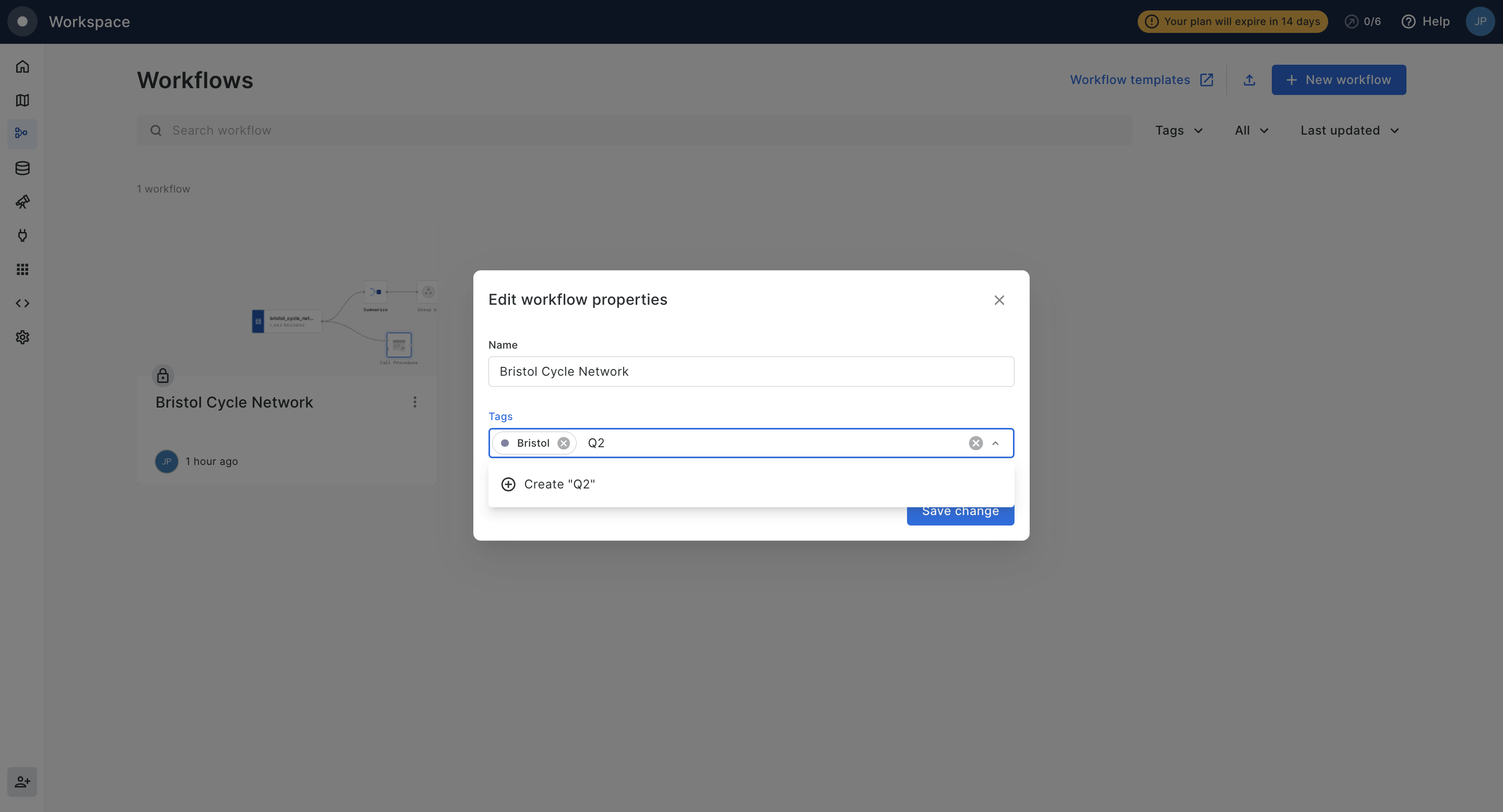
You can tag workflows from the Workspace by editing their properties:
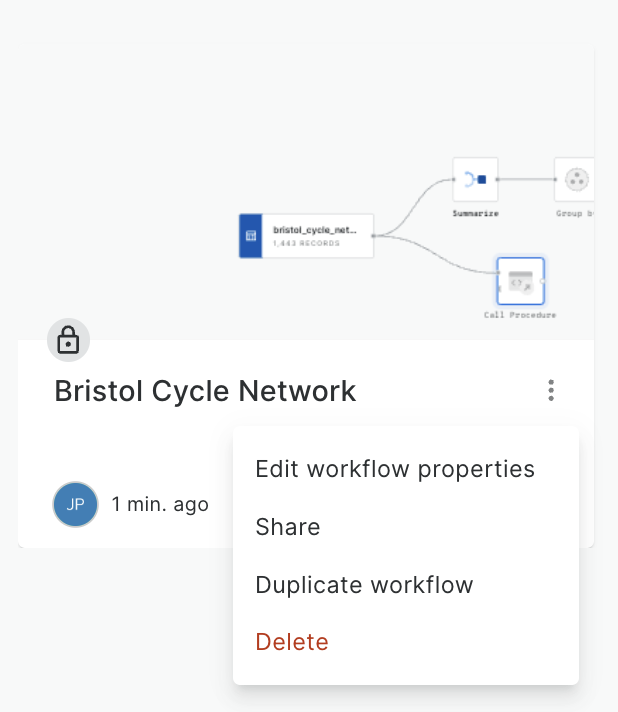
1. Click on the three dotted-button in the workflow card.
2. Select "Edit workflow properties".
3. Create, apply or remove existing tags in the tag input.
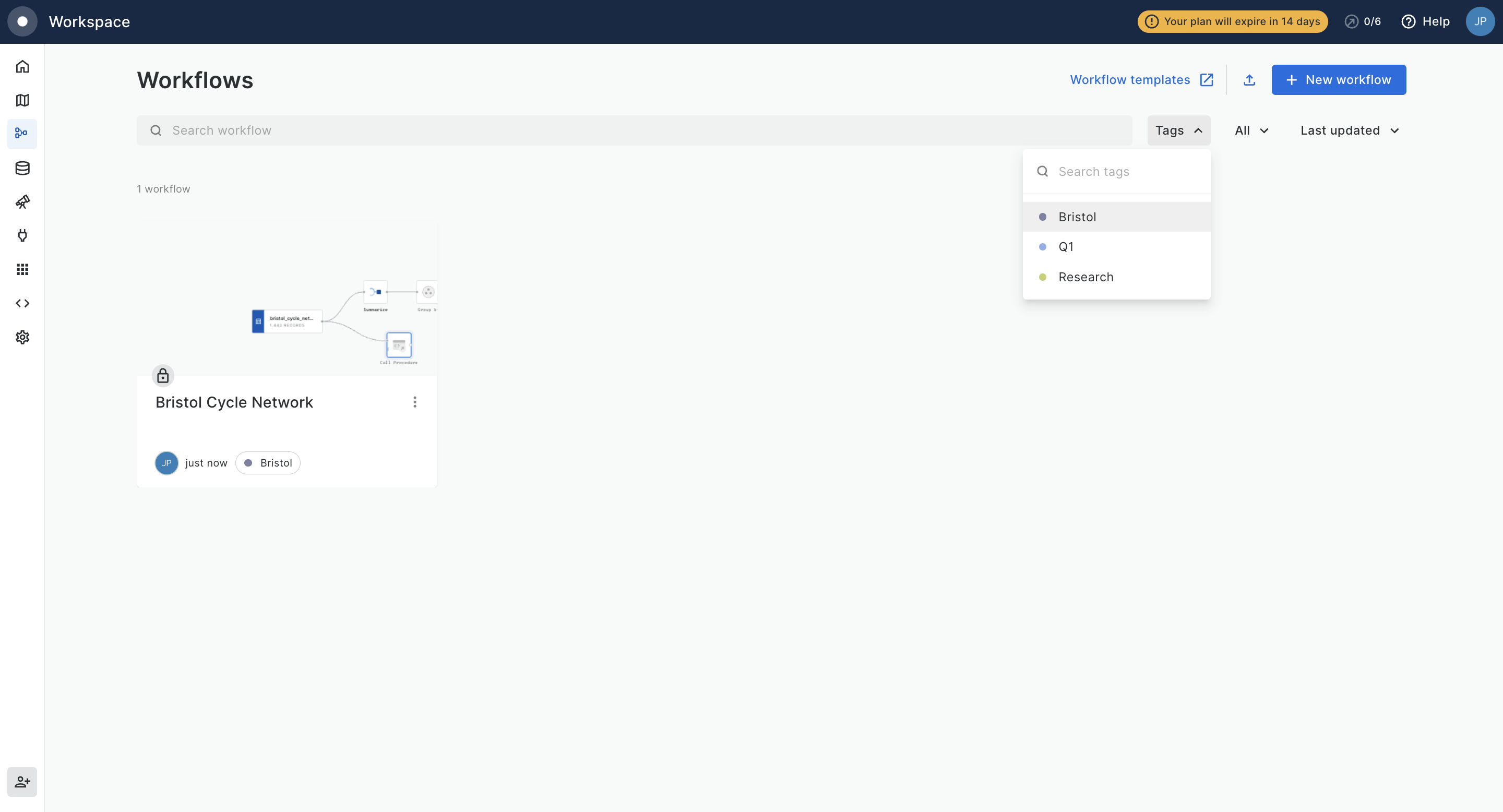
Additionally, you will be able to filter workflows by tags using the tag filter in the workspace. Once a tag filter is applied, you will be able to copy the URL and share it with other users within your organization.
Applying the tag filter in the Workspace
Tags are automatically deleted when they are no longer applied to any map or workflow.
### Duplicating workflows
To duplicate an existing workflow from the Workspace:
1. Click on the three-dotted menu in the workflow card.
2. Select "Duplicate Workflow".
{% hint style="info" %}
When duplicating a workflow, you will need access to the connection used in the original workflow. Otherwise, you will be prompted to select a new connection.
{% endhint %}
### Deleting workflows
To delete a workflow from the Workspace:
1. Click on the three-dotted menu in the workflow card.
2. Select "Delete workflow".
3. Confirm that you want to delete the selected workflow.
---
# Agent Instructions
This documentation is published with GitBook. GitBook is the documentation platform designed so that both humans and AI agents can read, navigate, and reason over technical content effectively. Learn more at gitbook.com.
## Querying This Documentation
If you need additional information that is not directly available in this page, you can query the documentation by asking a question.
Perform an HTTP GET request on the following URL with the `ask` and `goal` query parameters:
```
GET https://docs.carto.com/carto-user-manual/workflows/managing-maps.md?ask=&goal=
```
`ask` is the immediate question: it should be specific, self-contained, and written in natural language.
`goal` is what the user is ultimately trying to achieve, the reason they need the answer. Sharing it helps GitBook give you a better, more relevant answer. A goal is most helpful when it describes the outcome the user wants rather than restating the question. For example, with `ask=how do I create an API token`, a goal like `automate deployments from our CI pipeline` lets GitBook tailor the answer to that use case.
The response will contain a direct answer to the question and relevant excerpts and sources from the documentation.
Use this mechanism when the answer is not explicitly present in the current page, you need clarification or additional context, or you want to retrieve related documentation sections.