> For the complete documentation index, see [llms.txt](https://docs.carto.com/llms.txt). Markdown versions of documentation pages are available by appending `.md` to page URLs; this page is available as [Markdown](https://docs.carto.com/data-and-analysis/analytics-toolbox-overview.md).
# Analytics Toolbox Overview
The CARTO Analytics Toolbox is a suite of functions and procedures to easily enhance the geospatial capabilities available in the different leading cloud data warehouses.
It is currently available for Google BigQuery, Snowflake, Redshift, Databricks, PostgreSQL and Oracle.
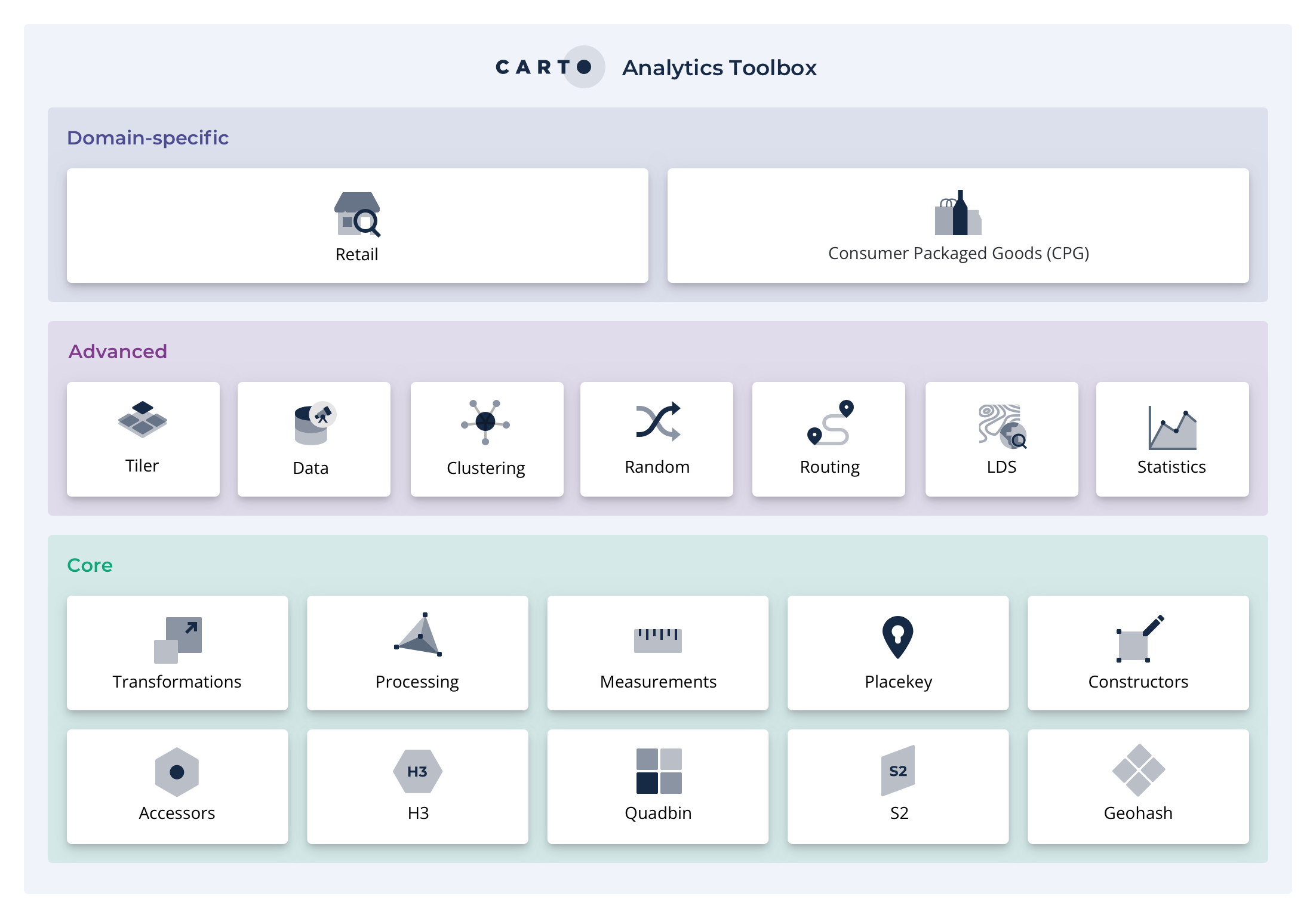
The Analytics Toolbox contains more than 100 advanced spatial functions, grouped in different modules.
## How does it work
Technically speaking, the CARTO Analytics Toolbox is a set of SQL UDFs and Stored Procedures that run natively within each data warehouse, leveraging their computational power and scalability and avoiding the need for time consuming ETL processes.
The functions can be executed directly from the CARTO Workspace or in your cloud data warehouse console and APIs, using SQL commands.
Here’s an example of a query that returns the compact H3 cells for a given region, using Analytics Toolbox functions such as `H3_POLYFILL()` or `H3_COMPACT()` from our H3 module.
Check the documentation for each data warehouse (listed below) for a complete SQL reference, guides, and examples.
```sql
WITH q AS (
SELECT `carto-un`.carto.H3_COMPACT(
`carto-un`.carto.H3_POLYFILL(geom,11)) as h3
FROM `carto-do-public-data.carto.geography_usa_censustract_2019`
WHERE geoid='36061009900'
)
SELECT h3 FROM q, UNNEST(h3) as h3
```
{% embed url="" %}
{% hint style="info" %}
Some Analytics Toolbox modules (e.g., Location Data Services) require an **AT Gateway** to connect your data warehouse to CARTO's APIs. The gateway deployment differs depending on whether you use CARTO Cloud or Self-Hosted. See [Analytics Toolbox Gateway](/data-and-analysis/analytics-toolbox-gateway.md) for details.
{% endhint %}
## Supported Data Warehouses
### **Google BigQuery**
Unlock advanced geospatial within Google Cloud. Find more information, guides, and examples here:
* [Analytics Toolbox for BigQuery](/data-and-analysis/analytics-toolbox-for-bigquery.md)
### **Snowflake**
Get your Snowflake geospatial capabilities to the next level, no matter what cloud you use. Find more information, guides, and examples here:
* [Analytics Toolbox for Snowflake](https://docs.carto.com/data-and-analysis/analytics-toolbox-for-snowflake)
### **Amazon Redshift**
Combine the power of Redshift with the geospatial capabilities of CARTO. Find more information, guides, and examples here:
* [Analytics Toolbox for Redshift](https://docs.carto.com/data-and-analysis/analytics-toolbox-for-redshift)
### **Databricks**
Use CARTO Analytics Toolbox natively in Databricks. Find more information, guides, and examples here:
* [Analytics Toolbox for Databricks](https://docs.carto.com/data-and-analysis/analytics-toolbox-for-databricks)
### **PostgreSQL**
Combine PostGIS with the CARTO Analytics Toolbox in your own PostgreSQL instance. Find more information, guides, and examples here:
* [Analytics Toolbox for PostgreSQL](https://docs.carto.com/data-and-analysis/analytics-toolbox-for-postgresql)
---
# Agent Instructions
This documentation is published with GitBook. GitBook is the documentation platform designed so that both humans and AI agents can read, navigate, and reason over technical content effectively. Learn more at gitbook.com.
## Querying This Documentation
If you need additional information that is not directly available in this page, you can query the documentation by asking a question.
Perform an HTTP GET request on the following URL with the `ask` and `goal` query parameters:
```
GET https://docs.carto.com/data-and-analysis/analytics-toolbox-overview.md?ask=&goal=
```
`ask` is the immediate question: it should be specific, self-contained, and written in natural language.
`goal` is what the user is ultimately trying to achieve, the reason they need the answer. Sharing it helps GitBook give you a better, more relevant answer. A goal is most helpful when it describes the outcome the user wants rather than restating the question. For example, with `ask=how do I create an API token`, a goal like `automate deployments from our CI pipeline` lets GitBook tailor the answer to that use case.
The response will contain a direct answer to the question and relevant excerpts and sources from the documentation.
Use this mechanism when the answer is not explicitly present in the current page, you need clarification or additional context, or you want to retrieve related documentation sections.