> For the complete documentation index, see [llms.txt](https://docs.carto.com/llms.txt). Markdown versions of documentation pages are available by appending `.md` to page URLs; this page is available as [Markdown](https://docs.carto.com/carto-user-manual/workflows/sharing-workflows.md).
# Sharing and collaboration
## Share with other users in your organization
This guide describes how you can share a workflow with the other users within your CARTO organization.
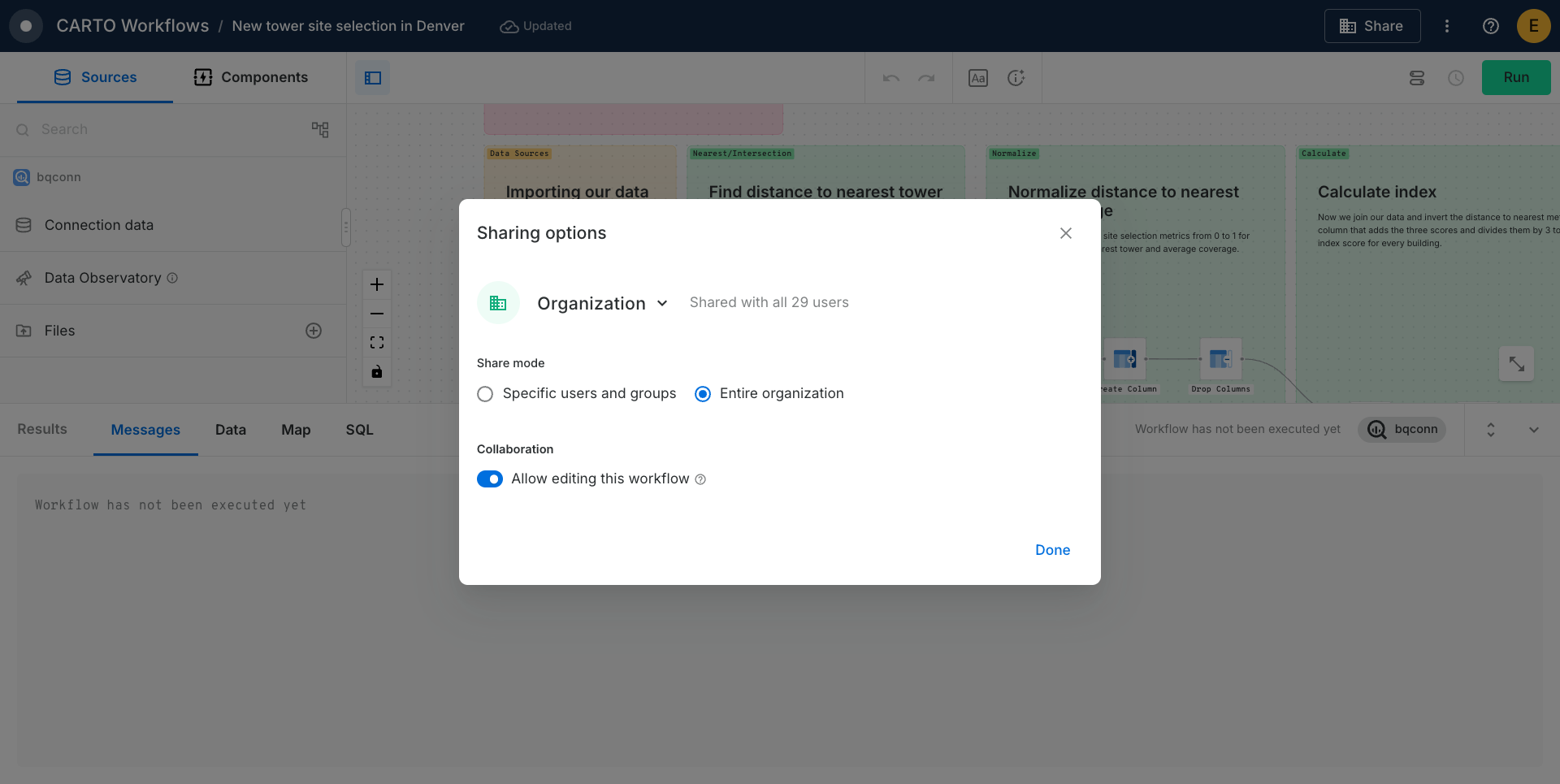
When you create a workflow, it starts as **Restricted** and only you can see it. To share a workflow, make sure it has a name, then click the ***Share*** **button in the top-right corner** to open the sharing options.
Workflows support two sharing modes:
* **Restricted:** Only the people you invite can access the workflow. Add specific users or groups from the *Add members or guests* field. If your organization has Single Sign-On (SSO) and **Groups** enabled, you can add groups as well as individual users. Read more about [Managing user groups](/carto-user-manual/settings/users-and-groups/managing-user-groups.md).
* **Organization:** Everyone in your organization can access the workflow. Editors can duplicate it to create their own copy and start working on it.
Switching modes keeps the users and groups you have already added, so you can move between Restricted and Organization without losing your selection. Only the owner can change how a workflow is shared; other users see the Share modal in read-only mode.
{% hint style="info" %}
To share several workflows at once, group them in a **project or folder** and share that. Every workflow inside inherits the project's sharing. See [Projects](/carto-user-manual/projects.md).
{% endhint %}
{% hint style="info" %}
A workflow inside a shared project or folder inherits that project's sharing. In the Share modal, access that comes from a parent project or folder is labeled **Access is inherited from an upper level**, so you can tell it apart from access set directly on the workflow.
{% endhint %}
## Editor collaboration
Enable the "*Allow editing this workflow*" option to allow collaboration from other editor users with access to the workflow.
After you enable this setting, all editors with access to this workflow will also be able to edit it. A few things to take into consideration:
* To enable editor collaboration, **the connection used to create the workflow also needs to be shared**.
* When using the CARTO Data Warehouse, or a connection with [Viewer Credentials](/carto-user-manual/connections/sharing-a-connection.md#requiring-viewer-credentials-on-shared-connections), each user will use their own [temporal storage for Workflows](/carto-user-manual/workflows/temporary-data-in-workflows.md), meaning that the result of each node and their execution status will not be shared.
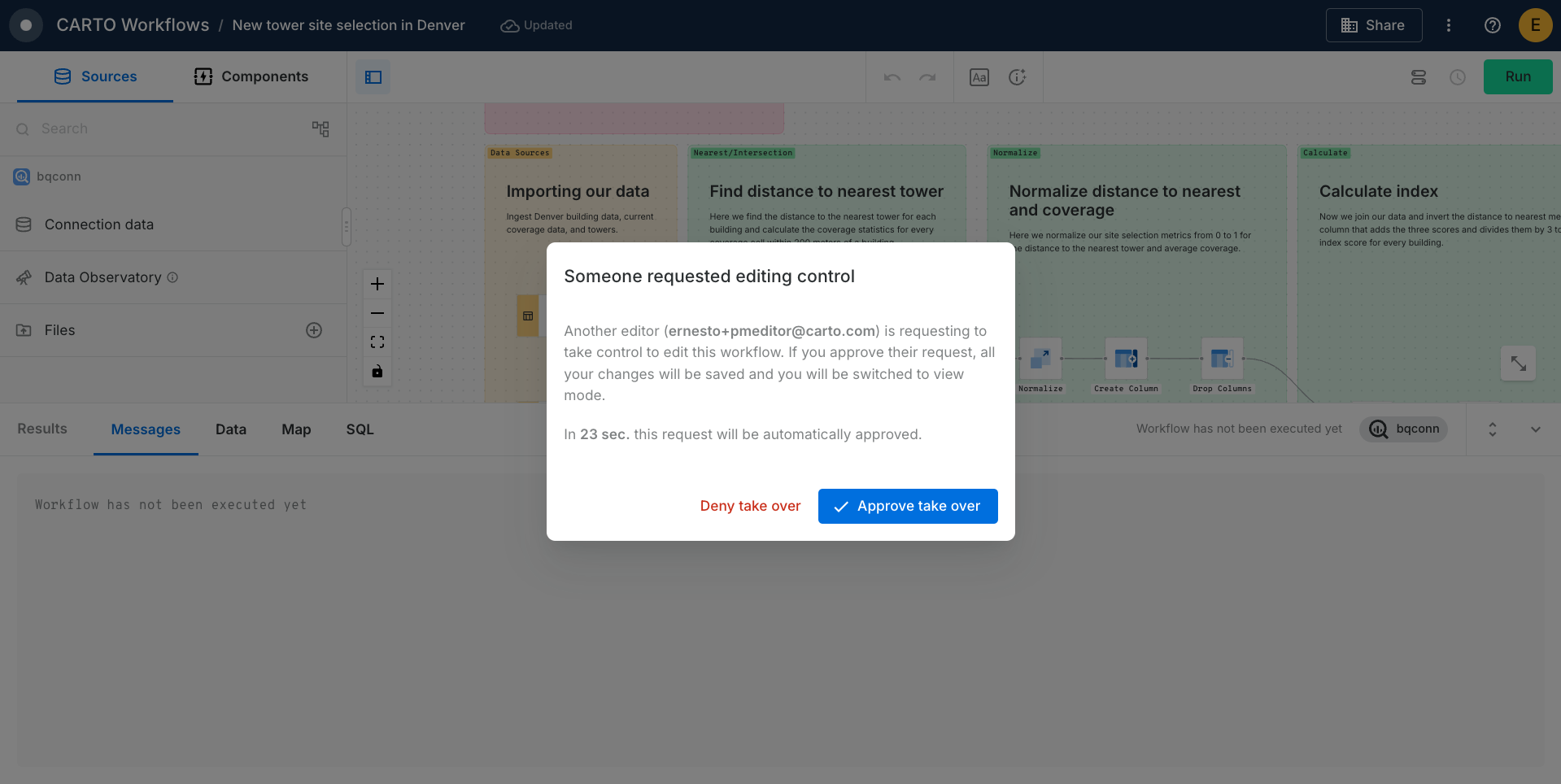
Collaboration is **asynchronous.** If two users try to open the workflow at the same time, a pop-up will appear to decide who will take control of the workflow at that moment. If the current editor is away from the keyboard, the new editor can take control of the workflow in 30 seconds.
The current editor can also choose to deny the take over, remaining in control of the workflow until the workflow is closed.
## Viewer Mode
Editors can also share workflows with **viewer access**, allowing other users to run the workflow with configurable parameters without being able to edit the canvas.
To set up a workflow for Viewer Mode, editors need to:
1. Define **viewer parameters** by marking variables with the Viewer scope.
2. Place a [**Viewer Result Output**](/carto-user-manual/workflows/components/input-output.md#viewer-result-output) component to define which results viewers can see.
3. Configure **viewer settings** in the Share dialog to control what viewers can access.
{% hint style="info" %}
For complete details on setting up and using Viewer Mode, see the dedicated [Viewer Mode](/carto-user-manual/workflows/viewer-mode.md) page.
{% endhint %}
## Export a workflow as a SQL file
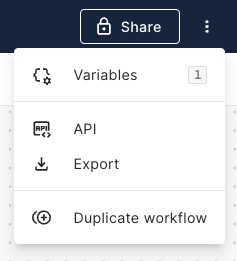
Click on the three dots in the upper-left corner and find 'Export'
This action will download a file that contains the SQL code needed to create a stored procedure based on the contents of your workflow. It will observe existing variables and parameters, the former being exposed as input parameters for the stored procedure.
## Import a workflow from a SQL file
A `.sql` file that was obtained by exporting a workflow can be imported to reproduce the same workflow. There are two different ways to import a workflow:
* Drag a drop a compatible `.sql` file into your Workflows page in Workspace.
* Click the import button next to *+ New workflow* and select a file from your computer.
{% embed url="" %}
---
# Agent Instructions
This documentation is published with GitBook. GitBook is the documentation platform designed so that both humans and AI agents can read, navigate, and reason over technical content effectively. Learn more at gitbook.com.
## Querying This Documentation
If you need additional information that is not directly available in this page, you can query the documentation by asking a question.
Perform an HTTP GET request on the following URL with the `ask` and `goal` query parameters:
```
GET https://docs.carto.com/carto-user-manual/workflows/sharing-workflows.md?ask=&goal=
```
`ask` is the immediate question: it should be specific, self-contained, and written in natural language.
`goal` is what the user is ultimately trying to achieve, the reason they need the answer. Sharing it helps GitBook give you a better, more relevant answer. A goal is most helpful when it describes the outcome the user wants rather than restating the question. For example, with `ask=how do I create an API token`, a goal like `automate deployments from our CI pipeline` lets GitBook tailor the answer to that use case.
The response will contain a direct answer to the question and relevant excerpts and sources from the documentation.
Use this mechanism when the answer is not explicitly present in the current page, you need clarification or additional context, or you want to retrieve related documentation sections.