> For the complete documentation index, see [llms.txt](https://docs.carto.com/llms.txt). Markdown versions of documentation pages are available by appending `.md` to page URLs; this page is available as [Markdown](https://docs.carto.com/carto-user-manual/maps/data-sources/rasters.md).
# Rasters
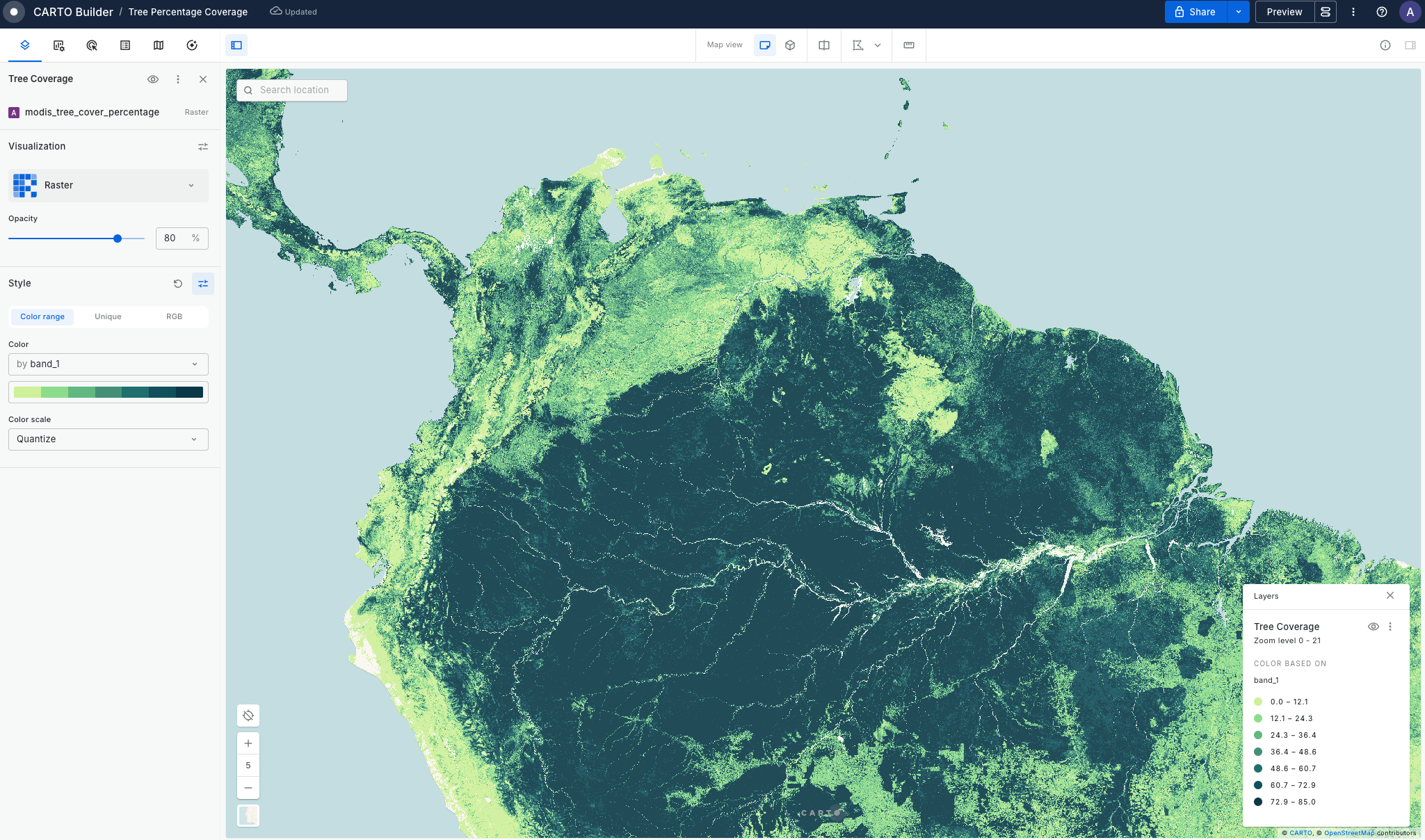
Raster data is composed of grids of pixels, where each pixel contains a value representing specific information, such as temperature, elevation, or vegetation indices. These datasets can represent continuous surfaces or sparse data with defined no-data regions. The CARTO platform provides seamless tools for importing, analyzing and visualizing raster sources directly in your data warehouse.
## Visualizing rasters
To visualize raster sources, they must first be stored in your data warehouse using the **CARTO raster loader**. This tool ensures your raster files are properly uploaded and formatted for seamless integration with the CARTO platform. [Learn more about preparing and uploading your raster data](/carto-user-manual/data-explorer/importing-data/importing-rasters.md).
To optimize performance, raster sources should include **overviews**—lower-resolution versions of the raster data—enabling efficient visualization at different zoom levels. Additionally, if your raster source contains a **color interpreter** (e.g., palette, grayscale, or RGB), CARTO will automatically apply default styling based on the metadata, making it easier to quickly render the raster on your map.
{% hint style="warning" %}
Note the current limitations and specific requirements for raster sources:
* Raster sources cannot be queried directly through SQL functions, meaning they are not compatible with **SQL Editor** or **SQL Parameters**. This is similar to the behavior of pre-generated tilesets.
* Raster sources are currently supported for **Google BigQuery, Snowflake and Databricks** environments.
{% endhint %}
---
# Agent Instructions
This documentation is published with GitBook. GitBook is the documentation platform designed so that both humans and AI agents can read, navigate, and reason over technical content effectively. Learn more at gitbook.com.
## Querying This Documentation
If you need additional information that is not directly available in this page, you can query the documentation dynamically by asking a question.
Perform an HTTP GET request on the current page URL with the `ask` query parameter, and the optional `goal` query parameter:
```
GET https://docs.carto.com/carto-user-manual/maps/data-sources/rasters.md?ask=&goal=
```
`ask` is the immediate question: it should be specific, self-contained, and written in natural language.
`goal` is optional and describes the broader end goal you are ultimately trying to accomplish on behalf of the user. GitBook uses it to tailor the answer towards what is most useful for that goal.
The response will contain a direct answer to the question and relevant excerpts and sources from the documentation.
Use this mechanism when the answer is not explicitly present in the current page, you need clarification or additional context, or you want to retrieve related documentation sections.