> For the complete documentation index, see [llms.txt](https://docs.carto.com/llms.txt). Markdown versions of documentation pages are available by appending `.md` to page URLs; this page is available as [Markdown](https://docs.carto.com/carto-user-manual/settings/advanced-settings/configuring-s3-bucket-integration-for-rds-for-postgresql-exports-in-builder.md).
# Configuring S3 Bucket integration for RDS for PostgreSQL Exports in Builder
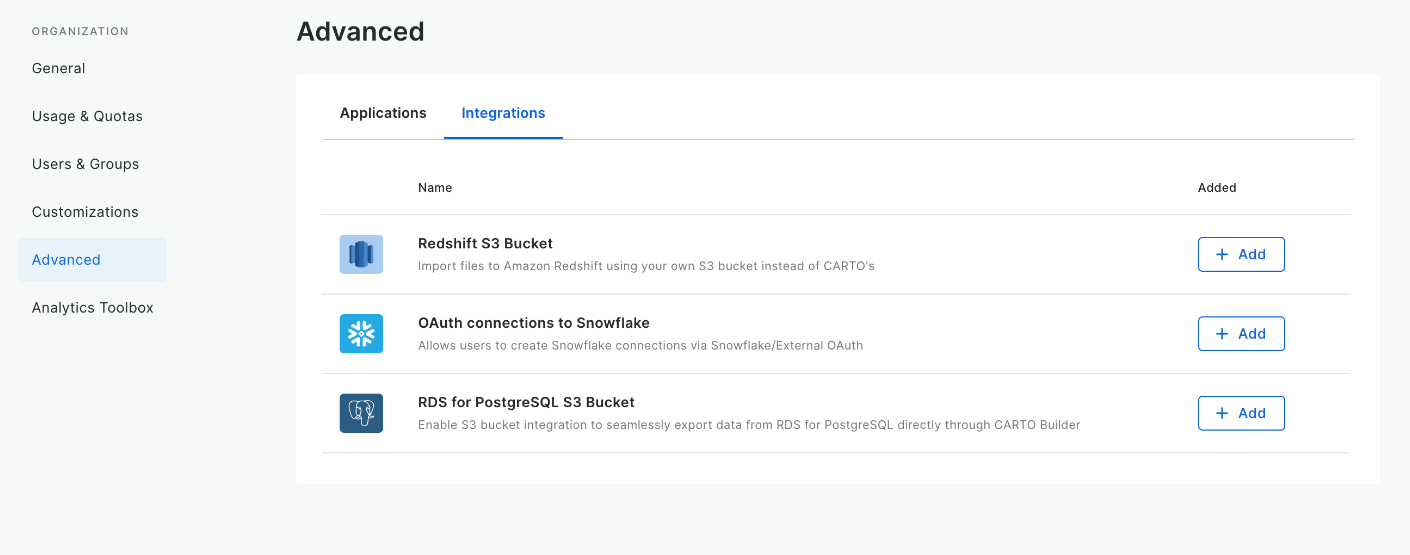
If you navigate to **Settings > Advanced Settings > Integrations**, you'll find a setting related to configuring your own S3 bucket to export data from RDS for PostgreSQL data sources in Builder.
## When is this needed?
Utilize this integration when you need to export geospatial data from your RDS for PostgreSQL database in Builder. CARTO incorporates an S3 bucket as a necessary intermediary step, adhering to the requirements of RDS for PostgreSQL.
{% hint style="warning" %}
**Requirements for Integration:**
1. **Private S3 Bucket**: Before you can configure this integration, create an S3 private bucket in AWS.
* **Best Practice**: We recommend setting up a new S3 bucket exclusively for this purpose, ensuring better organization and enhanced security.
2. **AWS S3 Extension Setup**: The integration also depends on the AWS S3 extension being pre-installed in your PostgreSQL environment.
* **Need Help?** If this step is not yet completed, or you need assistance with it, please refer to the [official AWS documentation](https://docs.aws.amazon.com/AmazonRDS/latest/UserGuide/postgresql-s3-export.html) for detailed guidance.
{% endhint %}
## Setting up your S3 bucket integration
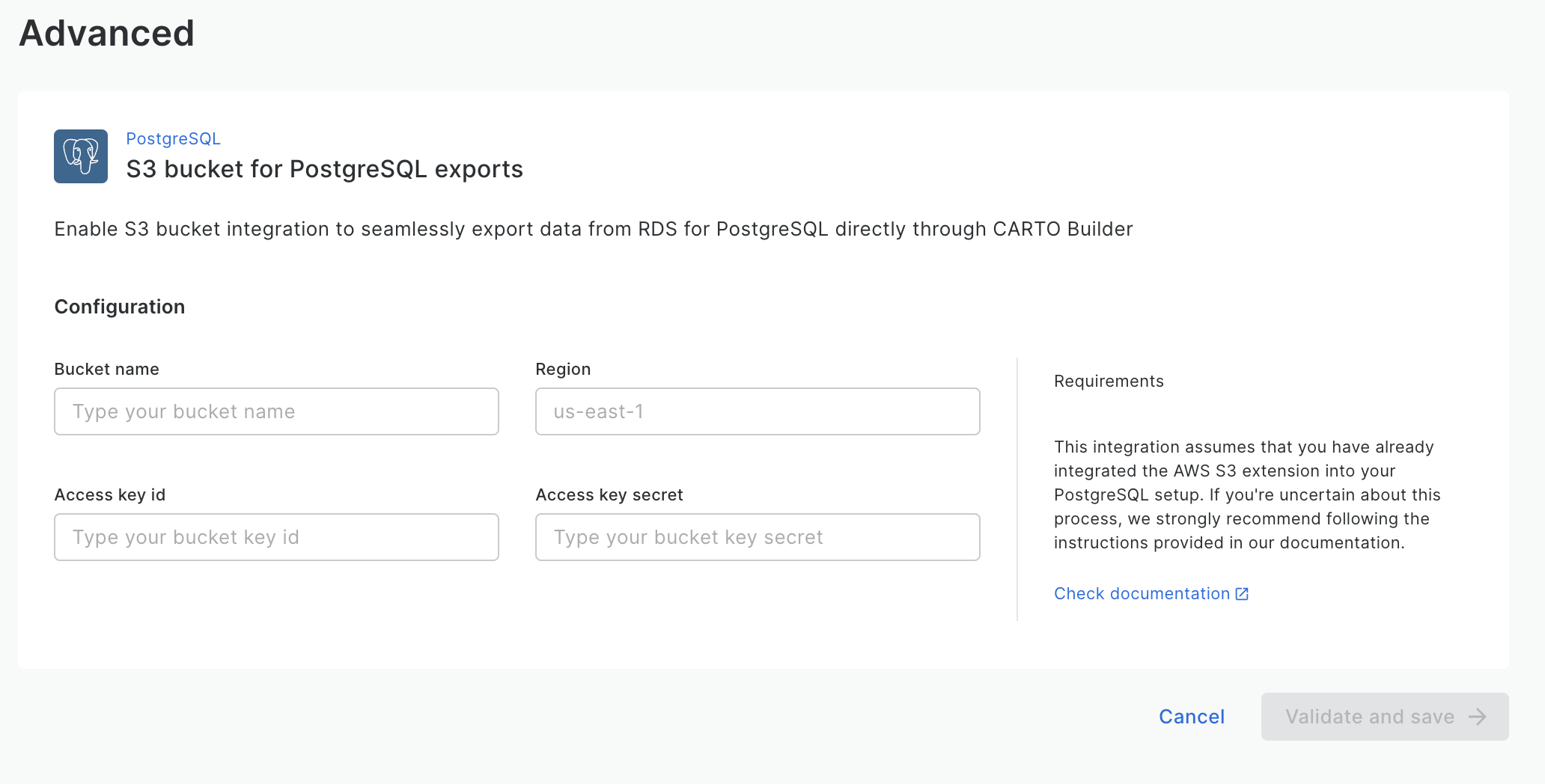
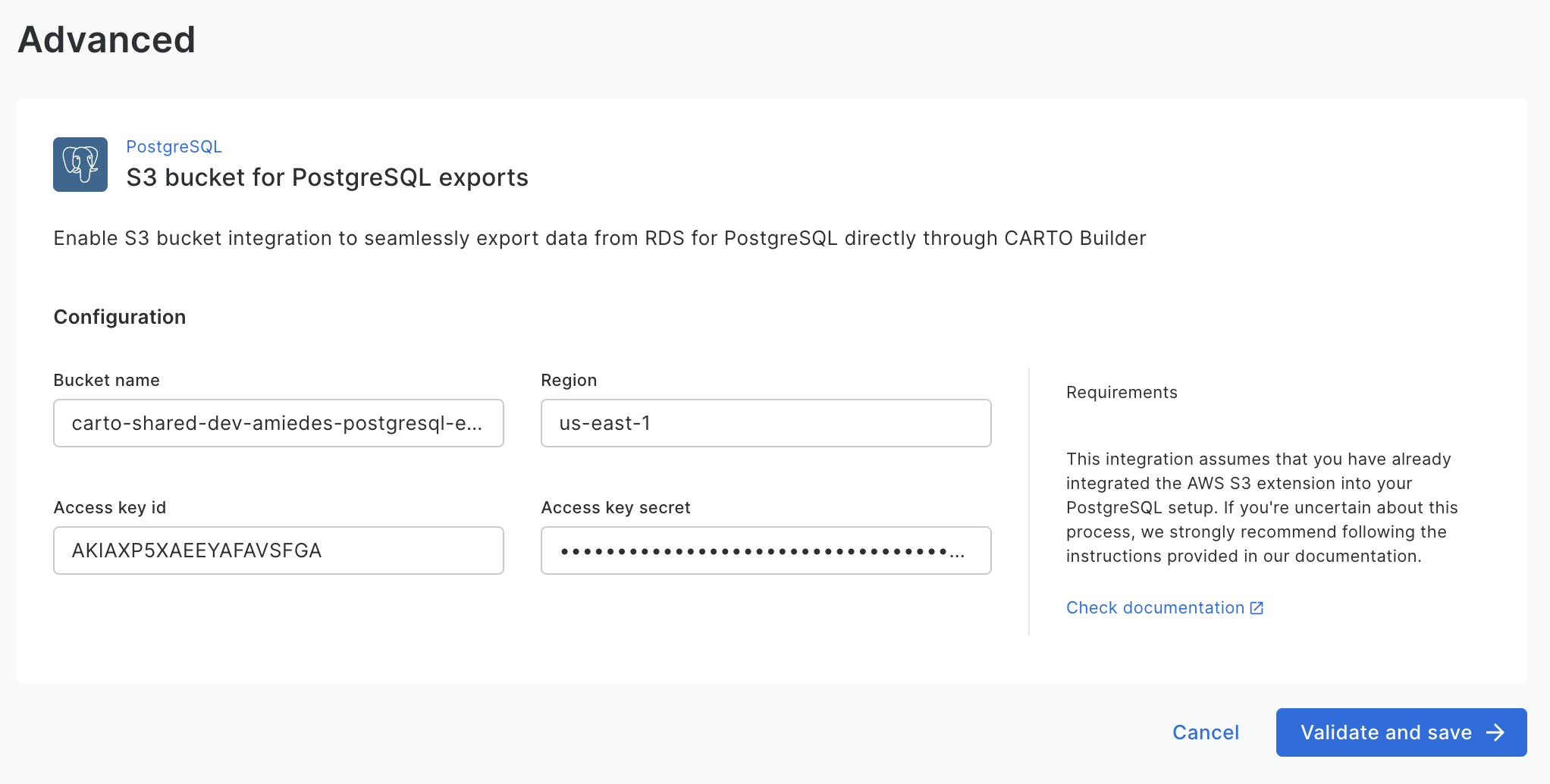
Start by clicking '+ Add' to initiate the setup. For your S3 private bucket, you'll need to provide the following four parameters:
* **Bucket Name**: Enter the name of your S3 bucket for data export.
* **Bucket Region**: Specify your S3 bucket's region.
* **Access Key ID**: Provide your AWS account's Access Key ID.
* **Access Key Secret**: Enter the corresponding Access Key Secret.
Once you've added the required fields, click on "**Validate and Save".** This will established the S3 bucket integration to enable RDS for PostgreSQL exports.
CARTO will validate your configuration at this point. If we're able to use your S3 bucket to export files from RDS for PostgreSQL, we'll take you back to your Settings page.
{% hint style="success" %}
From this point, CARTO will always use your S3 bucket when exporting sources from RDS for PostgreSQL, and the export viewport data feature in Builder will be enabled if it wasn't before
{% endhint %}
You can edit or remove this integration at any time.
---
# Agent Instructions
This documentation is published with GitBook. GitBook is the documentation platform designed so that both humans and AI agents can read, navigate, and reason over technical content effectively. Learn more at gitbook.com.
## Querying This Documentation
If you need additional information that is not directly available in this page, you can query the documentation by asking a question.
Perform an HTTP GET request on the following URL with the `ask` and `goal` query parameters:
```
GET https://docs.carto.com/carto-user-manual/settings/advanced-settings/configuring-s3-bucket-integration-for-rds-for-postgresql-exports-in-builder.md?ask=&goal=
```
`ask` is the immediate question: it should be specific, self-contained, and written in natural language.
`goal` is what the user is ultimately trying to achieve, the reason they need the answer. Sharing it helps GitBook give you a better, more relevant answer. A goal is most helpful when it describes the outcome the user wants rather than restating the question. For example, with `ask=how do I create an API token`, a goal like `automate deployments from our CI pipeline` lets GitBook tailor the answer to that use case.
The response will contain a direct answer to the question and relevant excerpts and sources from the documentation.
Use this mechanism when the answer is not explicitly present in the current page, you need clarification or additional context, or you want to retrieve related documentation sections.