> For the complete documentation index, see [llms.txt](https://docs.carto.com/llms.txt). Markdown versions of documentation pages are available by appending `.md` to page URLs; this page is available as [Markdown](https://docs.carto.com/carto-self-hosted/carto-self-hosted-legacy/guides/configure-an-external-proxy.md).
# Configure an external proxy
{% hint style="danger" %}
**This documentation is for the CARTO Self-Hosted Legacy Version**. Use only if you've installed this specific version. Explore our latest documentation for updated features.
{% endhint %}
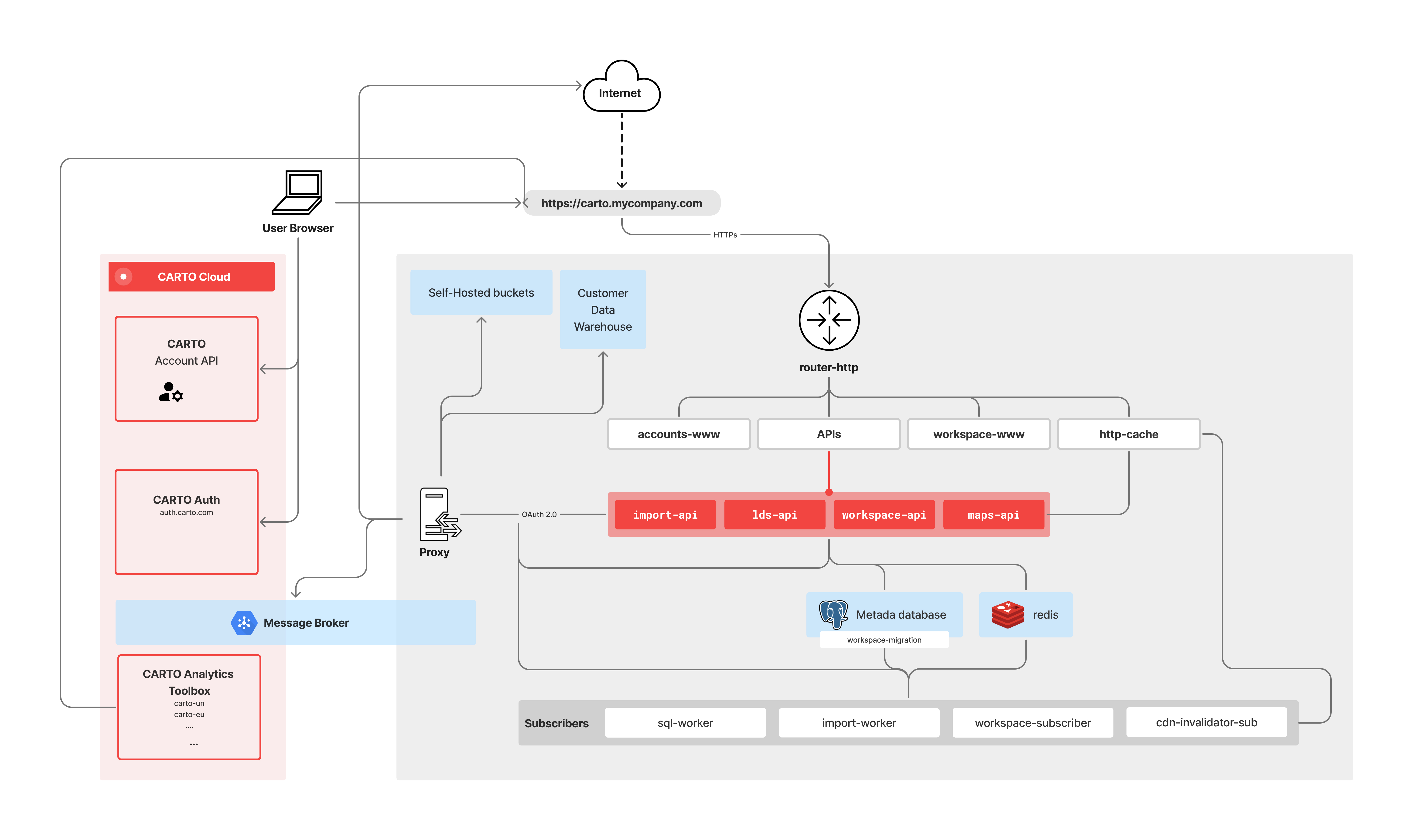
CARTO Self-hosted supports operating behind an HTTP or HTTPS proxy. The proxy acts as a gateway, enabling CARTO Self-hosted components to establish connections with essential external services like CARTO licensing system, or `auth.carto.com`. You can find detailed information about these components and services in the [network requirements](https://docs.carto.com/carto-self-hosted/key-concepts/deployment-requirements#network-egress-requirements) section.
**CARTO Self-hosted does not provide or install any proxy component**; It's built to connect to an existing proxy software deployed on your side.
A comprehensive list of domains that must be whitelisted by the proxy for the proper operation of CARTO Self-hosted can be found [here](https://docs.carto.com/carto-self-hosted/key-concepts/deployment-requirements#network-egress-requirements). Such list includes domains for the core services of CARTO Self-hosted, as well as some optional domains that should be enabled to access specific features.
## **HTTP**
In order to configure an external HTTP proxy on your CARTO Self-hosted installation, you'll have to:
Set the following environment variables (both in uppercase and lowercase) in your .env file:
```
HTTP_PROXY="http://my-proxy:3128"
http_proxy="http://my-proxy:3128"
HTTPS_PROXY="http://my-proxy:3128"
https_proxy="http://my-proxy:3128"
GRPC_PROXY="http://my-proxy:3128"
grpc_proxy="http://my-proxy:3128"
NO_PROXY="localhost,mega.io,dropbox.com,filestack.com"
no_proxy="localhost,mega.io,dropbox.com,filestack.com"
```
* `HTTP_PROXY` (mandatory): Proxy connection string, consisting of `http://:`.
* `HTTPS_PROXY` (mandatory): Same as `HTTP_PROXY`.
* `GRPC_PROXY` (mandatory): Same as `HTTP_PROXY`.
* `NO_PROXY` (optional): Comma-separated list of domains to exclude from proxying.
## **HTTPS**
To configure an HTTPS proxy on CARTO Self-hosted, you'll have to change the following configuration:
Set the following environment variables (both in uppercase and lowercase) in your .env file:
```yaml
HTTP_PROXY="https://my-proxy:3129"
http_proxy="https://my-proxy:3129"
HTTPS_PROXY="https://my-proxy:3129"
https_proxy="https://my-proxy:3129"
NO_PROXY="mega.io,dropbox.com,filestack.com"
no_proxy="mega.io,dropbox.com,filestack.com"
NODE_EXTRA_CA_CERTS=/opt/carto/certs/proxy-ca.crt
NODE_TLS_REJECT_UNAUTHORIZED=0
```
* `HTTP_PROXY` (mandatory): Proxy connection string, consisting of `https://:`.
* `HTTPS_PROXY` (mandatory): Same as `HTTP_PROXY`.
* `NO_PROXY` (optional): Comma-separated list of domains to exclude from proxying.
* `NODE_EXTRA_CA_CERTS` (optional): Path to the proxy CA certificate. If the proxy certificate is signed by a **custom CA**, such CA must be included here. If the proxy certificate is signed by a **well known CA**, there is no need to add it here. Well known CAs are usually part of the [ca-certificates package](https://askubuntu.com/questions/857476/what-is-the-use-purpose-of-the-ca-certificates-package)
* `NODE_TLS_REJECT_UNAUTHORIZED` (optional): Specify if CARTO Self-hosted should check if the proxy certificate is valid (`1`) or not (`0`). For instance, **self signed certificates** validation must be skipped.
## Support for data warehouses
While certain data warehouses can be configured to work with a proxy, **there are some providers that will inherently bypass it**. This means that the connection to these data warehouses won't be created through the proxy, so CARTO Self-hosted services will try to directly perform requests to the providers.
* **BigQuery**: It supports both HTTP and HTTPs proxy.
* **PostgreSQL and Redshift**: They use a TCP connection instead of HTTP(S), so the proxy is bypassed.
* **Databricks**: Proxy is not supported, so the HTTPS connection will be bypassed.
* **Snowflake:** It supports HTTP proxy, but HTTPS is not supported and will have to be bypassed. In order to bypass it, you'll have to add `snowflakecomputing.com` to the list of excluded domains.
{% hint style="info" %}
When the proxy is bypassed, and you have a restrictive network policy in place, you will need to explicitly allow this egress of non-proxied traffic.
{% endhint %}
## Limitations
Password authentication is not supported for the proxy connection.
[Importing data](https://docs.carto.com/carto-user-manual/data-explorer/importing-data) using an HTTPS Proxy configured with a certificate signed by a Custom CA\
is not supported.
---
# Agent Instructions
This documentation is published with GitBook. GitBook is the documentation platform designed so that both humans and AI agents can read, navigate, and reason over technical content effectively. Learn more at gitbook.com.
## Querying This Documentation
If you need additional information that is not directly available in this page, you can query the documentation by asking a question.
Perform an HTTP GET request on the following URL with the `ask` and `goal` query parameters:
```
GET https://docs.carto.com/carto-self-hosted/carto-self-hosted-legacy/guides/configure-an-external-proxy.md?ask=&goal=
```
`ask` is the immediate question: it should be specific, self-contained, and written in natural language.
`goal` is what the user is ultimately trying to achieve, the reason they need the answer. Sharing it helps GitBook give you a better, more relevant answer. A goal is most helpful when it describes the outcome the user wants rather than restating the question. For example, with `ask=how do I create an API token`, a goal like `automate deployments from our CI pipeline` lets GitBook tailor the answer to that use case.
The response will contain a direct answer to the question and relevant excerpts and sources from the documentation.
Use this mechanism when the answer is not explicitly present in the current page, you need clarification or additional context, or you want to retrieve related documentation sections.