> For the complete documentation index, see [llms.txt](https://docs.carto.com/llms.txt). Markdown versions of documentation pages are available by appending `.md` to page URLs; this page is available as [Markdown](https://docs.carto.com/whats-new/q1-2026.md).
# Q1 2026
New features and improvements introduced from January to March 2026
{% updates %}
{% update date="2026-03-30" tags="new,carto-for-developers" %}
## Build AI-first spatial apps with CARTO Agentic Tools for developers
Building AI-powered apps with geospatial capabilities just got a lot easier. We're releasing `@carto/agentic-deckgl`, an open-source TypeScript library built on [CARTO + deck.gl](https://carto.com/blog/modern-spatial-app-development-carto/) that lets any AI Agent create and style map layers, run spatial analytics, and interact with the map through natural language — with one npm install. It's framework-agnostic, includes Zod-validated tool definitions, a geospatial system prompt builder, and SDK converters for major AI frameworks.
The library gives AI Agents full control over the map experience: creating and styling vector tile, H3, GeoJSON, and raster layers from any CARTO data source; navigating the globe with smooth transitions; switching basemaps; placing and managing markers; applying spatial filters from user-drawn areas or analytical workflows; and managing widgets, visual effects, and layer ordering.
Learn more about this new library in our [product announcement](https://carto.com/blog/carto-agentic-tools-for-developers/).
{% endupdate %}
{% update date="2026-03-30" tags="new,builder" %}
## Create AI Agents through conversation with the new Configuration Assistant
Creating AI Agents just got significantly easier. The new **Agent Configuration Assistant** lets you design, set up, and iterate on your agents using natural language.
Instead of manually defining instructions, selecting tools, and configuring capabilities step by step, you can now **simply describe what your agent should do**. The Assistant generates a complete configuration for you — including the use case, structured instructions, model selection, tool setup, capabilities, and a tailored introduction message.
The Assistant is context-aware, meaning its recommendations are grounded in your actual map. It understands your datasets, layers, widgets, and available tools, helping you create more accurate and relevant agents from the start. You can refine any part of the configuration through conversation or combine it with manual edits for full control.
[Learn more about the Agent Config Assistant in our documentation.](/carto-user-manual/ai-agents/agent-config-assistant.md)
{% endupdate %}
{% update date="2026-03-27" tags="new,workflows" %}
## Viewer Mode for Workflows
Workflows can now be shared with **Viewer Mode**, allowing editors to publish interactive workflows that other users can run without editing the canvas. This opens up new possibilities for delivering analytical tools and reports to stakeholders and business users.
* **Viewer parameters**: Editors define which variables are exposed to viewers as configurable parameters, with custom display names and helper text. Supported types include Number, String, and the new **Geo** type, which lets viewers draw geographic features on a map.
* **Viewer Result Output**: A new component that defines which node's output is displayed to viewers, giving editors full control over what results are visible.
* **Viewer settings**: Granular controls over the viewer experience, including toggling the canvas visibility, SQL preview, data export, result caching, and more.
[Learn more about Viewer Mode in our documentation](/carto-user-manual/workflows/viewer-mode.md).
{% embed url="" %}
{% endupdate %}
{% update date="2026-03-19" tags="improvement,platform" %}
## Claude 4.6 models now available for AI Agents
We've expanded the AI models available for AI Agents with the latest generation of Anthropic models.
* **More CARTO-managed models:** Claude Opus 4.6 and Claude Sonnet 4.6 are now available out of the box with no additional configuration.
* **Broader bring-your-own-model support:** You can now use Claude Opus 4.6 and Claude Sonnet 4.6 through any of our supported providers, including Vertex AI, AWS Bedrock, Azure OpenAI, Anthropic, Snowflake Cortex, and Databricks Serving Model.
The 4.6 models deliver better performance across reasoning, tool usage, and complex geospatial workflows.
Configure your models in **Settings > CARTO A**I — see the [CARTO AI documentation](/carto-user-manual/settings/carto-ai.md) for the full list of supported models and providers.
{% endupdate %}
{% update date="2026-02-17" tags="improvement,platform" %}
## Additional AI models to power your Agents
We've expanded the AI models available for AI Agents with more advanced models from Anthropic, Google, and OpenAI.
* **More CARTO-managed models:** Claude Opus 4.5, Claude Sonnet 4.5, Gemini 3 Pro, and Gemini 3 Flash are now available out of the box with no additional configuration.
* **Broader bring-your-own-model support:** You can now use Gemini 3, Claude Opus 4.5, and GPT-5.2 through any of our supported providers, including Vertex AI, Google AI Studio, Snowflake Cortex, Databricks Serving Model, AWS Bedrock, Azure OpenAI, OpenAI, and Anthropic.
We recommend upgrading to the newest models available — you'll see a significant improvement in agent performance, reasoning, and tool usage.
Configure your models in **Settings > CARTO AI** — see the [CARTO AI documentation](/carto-user-manual/settings/carto-ai.md) for the full list of supported models and providers.
{% endupdate %}
{% update date="2026-02-09" tags="improvement,builder" %}
## AI Agents now create interactive charts
[AI Agents](/carto-user-manual/ai-agents.md) can now generate and render interactive charts directly inside the conversation. Users can ask for data visualizations and see charts rendered inline — no need to leave the chat.
Charts expand the way AI Agents can communicate insights, complementing map layers with statistical visualizations like bar charts for comparisons, line charts for trends, or histograms for distributions. Combined with other tools, AI Agents can query your data, analyze it, and present findings in the format that best fits the question.
[Learn more about AI Agent tools in our documentation](/carto-user-manual/ai-agents/working-with-tools.md).
{% endupdate %}
{% update date="2026-01-29" tags="new,platform" %}
## Introducing our new Command-line Interface
We're excited to announce the [CARTO CLI](https://carto.com/blog/carto-cli-automateed-carto-management-build-for-ai-agents), which brings command line power to your CARTO organization. Manage Maps, Workflows, connections and credentials; transfer assets between organizations, and query your organization's activity data; all from the terminal!
The CLI supports structured JSON output, non-interactive execution, and headless authentication, making it a natural interface to script and automate. To get started, head over to our [CARTO CLI documentation](/carto-for-agents/cli.md).
{% endupdate %}
{% update date="2026-01-29" tags="improvement,workspace" %}
## Tracking activity data from public maps
Public maps are the way to distribute geospatial data and insights across wider audiences outside your organization. From coverage maps to deforestation storytelling, many geospatial dashboards are making an impact on public websites thanks to CARTO.
Starting now, CARTO administrators can measure that impact, and answer questions like:
* **How many times my public maps have been viewed**
* **Which are my most active public maps**
* **How many exports from public maps last month...**
We've automatically added to our [Activity Data](/carto-user-manual/settings/activity-data.md) the data coming from your public maps thanks to a robust, secure, event pipeline that can track millions of events coming from unauthenticated users.
To get started, simply [export your Activity Data](/carto-user-manual/settings/activity-data.md) or [integrate it via API](/carto-user-manual/settings/activity-data.md#access-via-api).
{% endupdate %}
{% update date="2026-01-20" tags="new,platform" %}
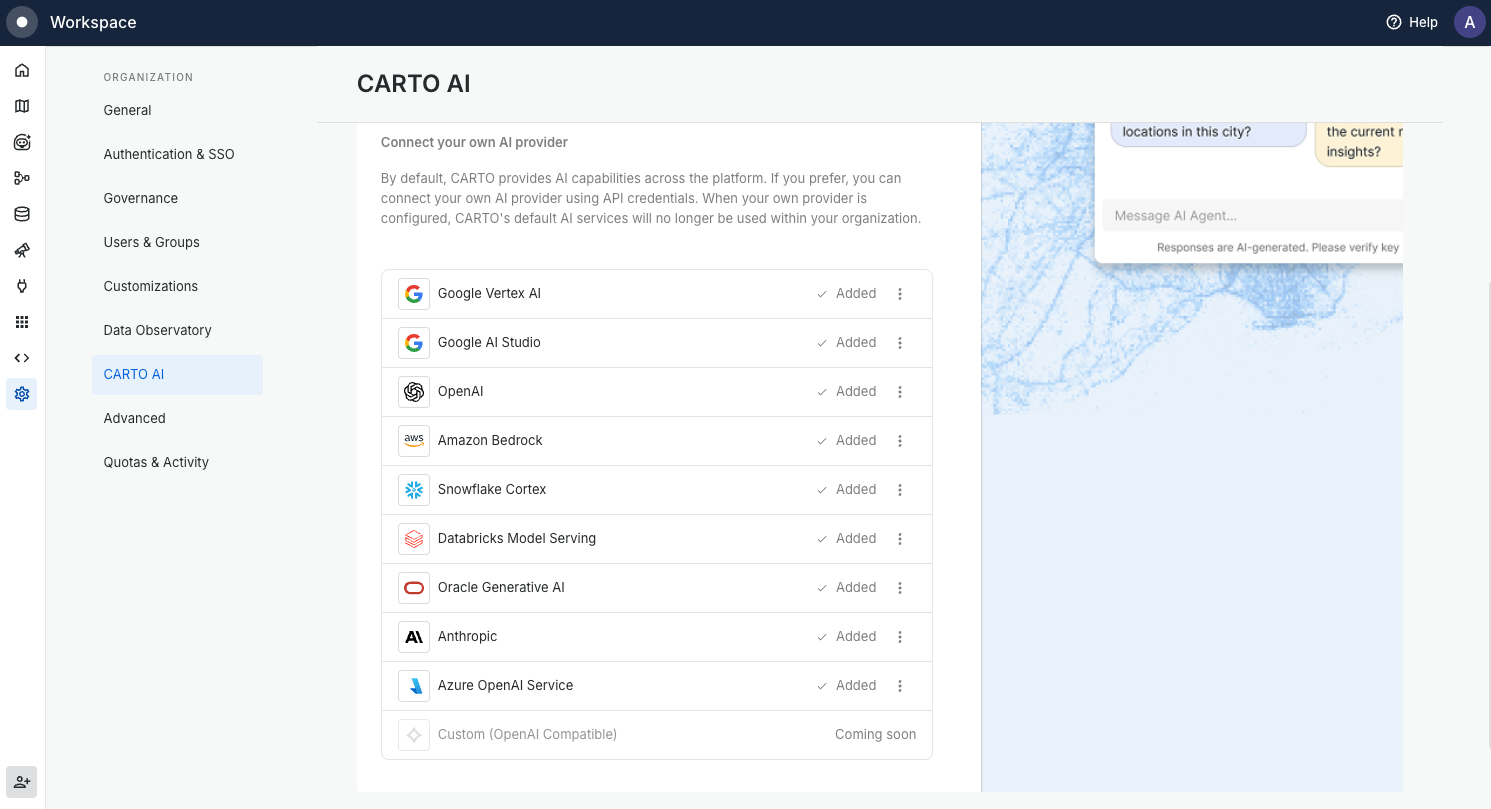
## New AI provider and LLM integrations to power your AI Agents
CARTO now supports seven additional AI providers, expanding the AI and LLM integrations available to power **AI Agents**.
Previously limited to **OpenAI** and **Google AI Studio**, you can now connect AI Agents to models hosted on your preferred cloud or data platform:
* **Google Vertex AI**: Enterprise GCP deployments with service account authentication.
* **Amazon Bedrock**: Claude models through AWS infrastructure.
* **Snowflake Cortex**: AI models within your Snowflake environment.
* **Databricks Model Serving**: Models through Databricks endpoints.
* **Oracle Generative AI**: Access to models via OCI.
* **Anthropic**: Direct access to Claude models.
* **Azure OpenAI Service**: OpenAI models through Azure.
These new integrations allow AI Agents to run on your preferred cloud or data platform, leverage existing cloud contracts, meet data residency requirements, and access the latest large language models available from each provider.
Configure providers in **Settings > CARTO AI**. See the [CARTO AI documentation](/carto-user-manual/settings/carto-ai.md) for setup instructions.
{% endupdate %}
{% update date="2026-01-14" tags="improvement,builder" %}
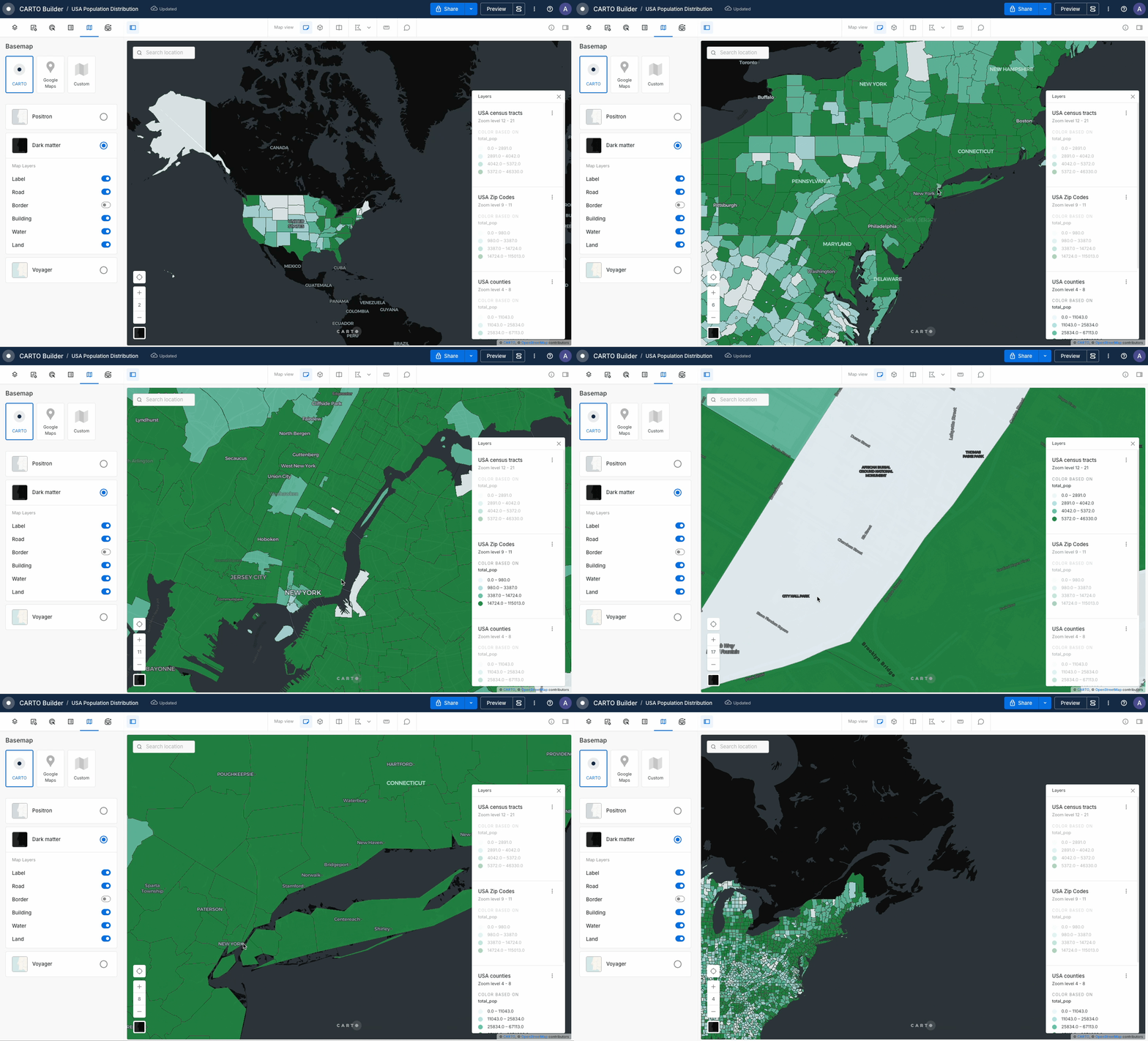
## CARTO Basemap labels now stay on top of your layers
When using CARTO Basemaps, labels (like city and street names) now automatically appear on top of your map layers instead of being hidden underneath them.
This makes it easier to read your maps, especially when working with multiple overlapping layers. You can still turn labels off in the basemap settings if you prefer a cleaner look.
{% endupdate %}
{% update date="2026-01-12" tags="new,workflows,analytics-toolbox" %}
## H3-based isochrones powered by TravelTime
A new capability is now available for generating **H3-based isochrones** using [TravelTime](https://docs.traveltime.com/api/reference/h3), expanding how accessibility and travel-time analysis can be performed in CARTO.
This release introduces a new endpoint in the **Location Data Services (LDS) API** that leverages TravelTime’s H3 isochrone support. In addition, corresponding functions are available in the **Analytics Toolbox** (for [BigQuery](/data-and-analysis/analytics-toolbox-for-bigquery/sql-reference/lds.md#create_h3_isolines), [Snowflake](/data-and-analysis/analytics-toolbox-for-snowflake/sql-reference/lds.md#create_h3_isolines), [Databricks](/data-and-analysis/analytics-toolbox-for-databricks/reference/lds.md#create_h3_isolines) and [Redshift](/data-and-analysis/analytics-toolbox-for-redshift/sql-reference/lds.md#create_h3_isolines)), along with a new [Create H3 Isolines](/carto-user-manual/workflows/components/spatial-constructors.md#create-h3-isolines) component in **Workflows**, enabling low-code and programmatic access to this functionality.
Customers can now generate H3-indexed isochrones directly, with support for the same configuration options provided by the underlying TravelTime API, including **departure time** and **transport mode**. Using H3 as the output format simplifies downstream analysis, aggregation, and visualization, particularly for workflows that already rely on hexagonal indexing.
{% embed url="" %}
{% endupdate %}
{% update date="2026-01-07" tags="new,platform" %}
## Full support for new Databricks Spatial SQL functions and data types
A new [Databricks connection](/carto-user-manual/connections/databricks.md) type is now generally available across all CARTO accounts, delivering deeper and more modern support for Databricks as a data warehouse and compute platform.
This integration adopts **Databricks SQL Warehouses** as the sole compute resource, providing a serverless, cloud-native experience without the need to manage traditional compute clusters. It also leverages Databricks’ [**native spatial capabilities**](https://www.databricks.com/blog/introducing-spatial-sql-databricks-80-functions-high-performance-geospatial-analytics?utm_source=chatgpt.com), including the GEOMETRY data type and Spatial SQL functions documented by Databricks, enabling efficient storage and processing of spatial data directly in SQL without external libraries.
Connectivity options include **Personal Access Tokens (PAT), M2M, and U2M integrations**, offering flexibility in how authentication and access are managed. Builder and Workflows fully support Databricks tables with geometry types out of the box, including query sources, SQL parameters, Location Data Services, and Create Builder Map workflows — no additional data preparation is required to work with spatial columns.
The [**Analytics Toolbox**](/data-and-analysis/analytics-toolbox-for-databricks.md) now installs directly into the Databricks Unity Catalog with no external dependencies, simplifying governance and deployment. Older Databricks connection types remain available for existing accounts that used them previously. This release represents a significant step in CARTO’s support for major cloud data warehouse providers and extends CARTO’s capabilities for spatial analytics on modern data platforms.
{% endupdate %}
{% endupdates %}
---
# Agent Instructions
This documentation is published with GitBook. GitBook is the documentation platform designed so that both humans and AI agents can read, navigate, and reason over technical content effectively. Learn more at gitbook.com.
## Querying This Documentation
If you need additional information that is not directly available in this page, you can query the documentation by asking a question.
Perform an HTTP GET request on the following URL with the `ask` and `goal` query parameters:
```
GET https://docs.carto.com/whats-new/q1-2026.md?ask=&goal=
```
`ask` is the immediate question: it should be specific, self-contained, and written in natural language.
`goal` is what the user is ultimately trying to achieve, the reason they need the answer. Sharing it helps GitBook give you a better, more relevant answer. A goal is most helpful when it describes the outcome the user wants rather than restating the question. For example, with `ask=how do I create an API token`, a goal like `automate deployments from our CI pipeline` lets GitBook tailor the answer to that use case.
The response will contain a direct answer to the question and relevant excerpts and sources from the documentation.
Use this mechanism when the answer is not explicitly present in the current page, you need clarification or additional context, or you want to retrieve related documentation sections.