> For the complete documentation index, see [llms.txt](https://docs.carto.com/llms.txt). Markdown versions of documentation pages are available by appending `.md` to page URLs; this page is available as [Markdown](https://docs.carto.com/carto-user-manual/connections/oracle.md).
# Oracle
You can use CARTO with your data in an Oracle database, with full support for Oracle Spatial (`SDO_GEOMETRY`) and GeoRaster data types. **CARTO supports Oracle Database 19c and higher.** See the [Supported Features](#supported-features) and [Analytics Toolbox & Workflows](#analytics-toolbox-and-workflows) sections for details on what's included.
## Authentication with Oracle Wallet
Oracle connections in CARTO use **Oracle Wallet** for secure authentication. [Oracle Wallet](https://docs.oracle.com/cd/E92519_02/pt856pbr3/eng/pt/tsvt/concept_UnderstandingOracleWallet.html?pli=ul_d96e224_tsvt) is a container that stores authentication and signing credentials, including private keys, certificates, and trusted certificates needed for secure connections.
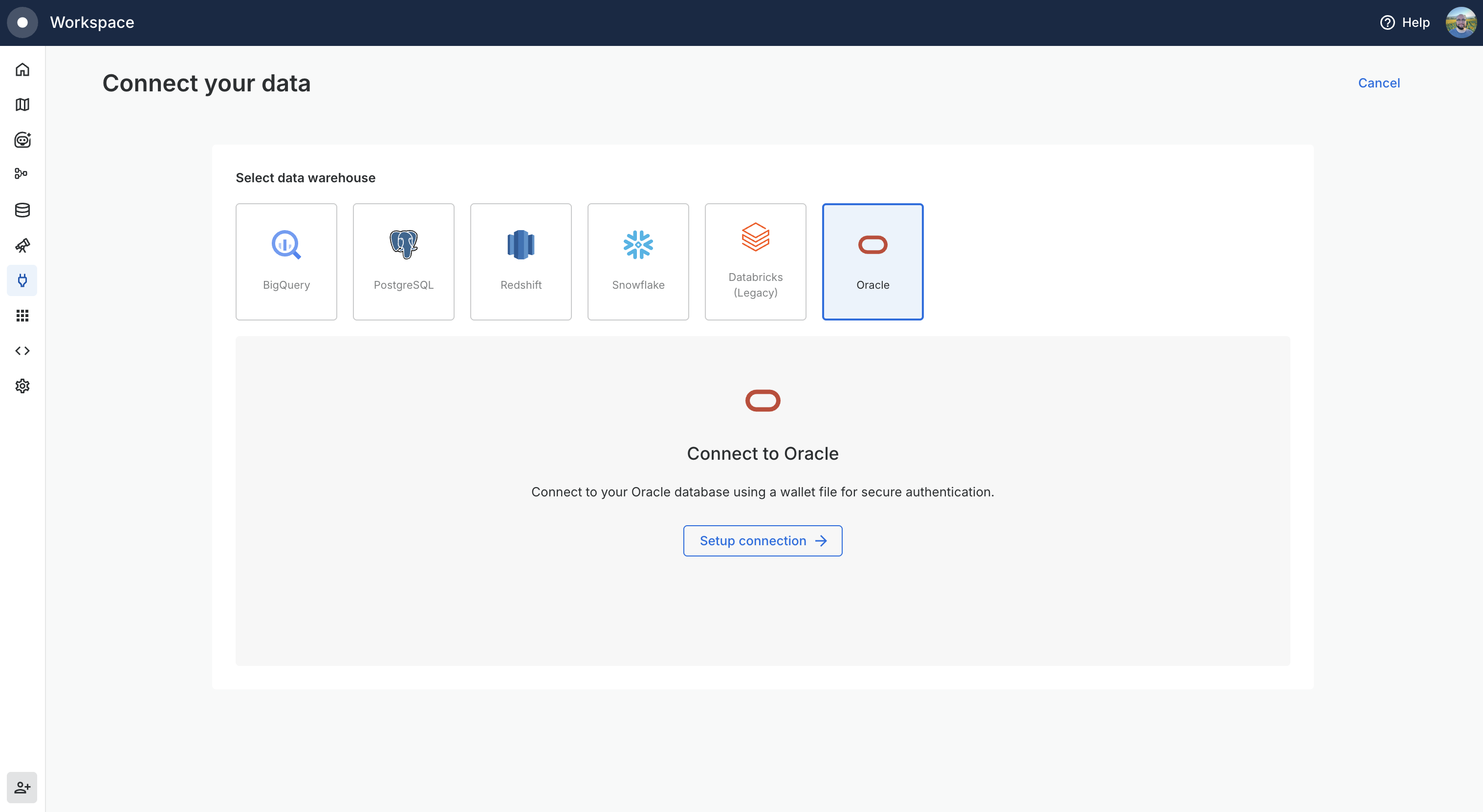
If you want to create a connection to your Oracle database, you need to select the Oracle connector in the *New connection* dialog. After you select the connector click on the *Setup connection* button.
### Required Parameters
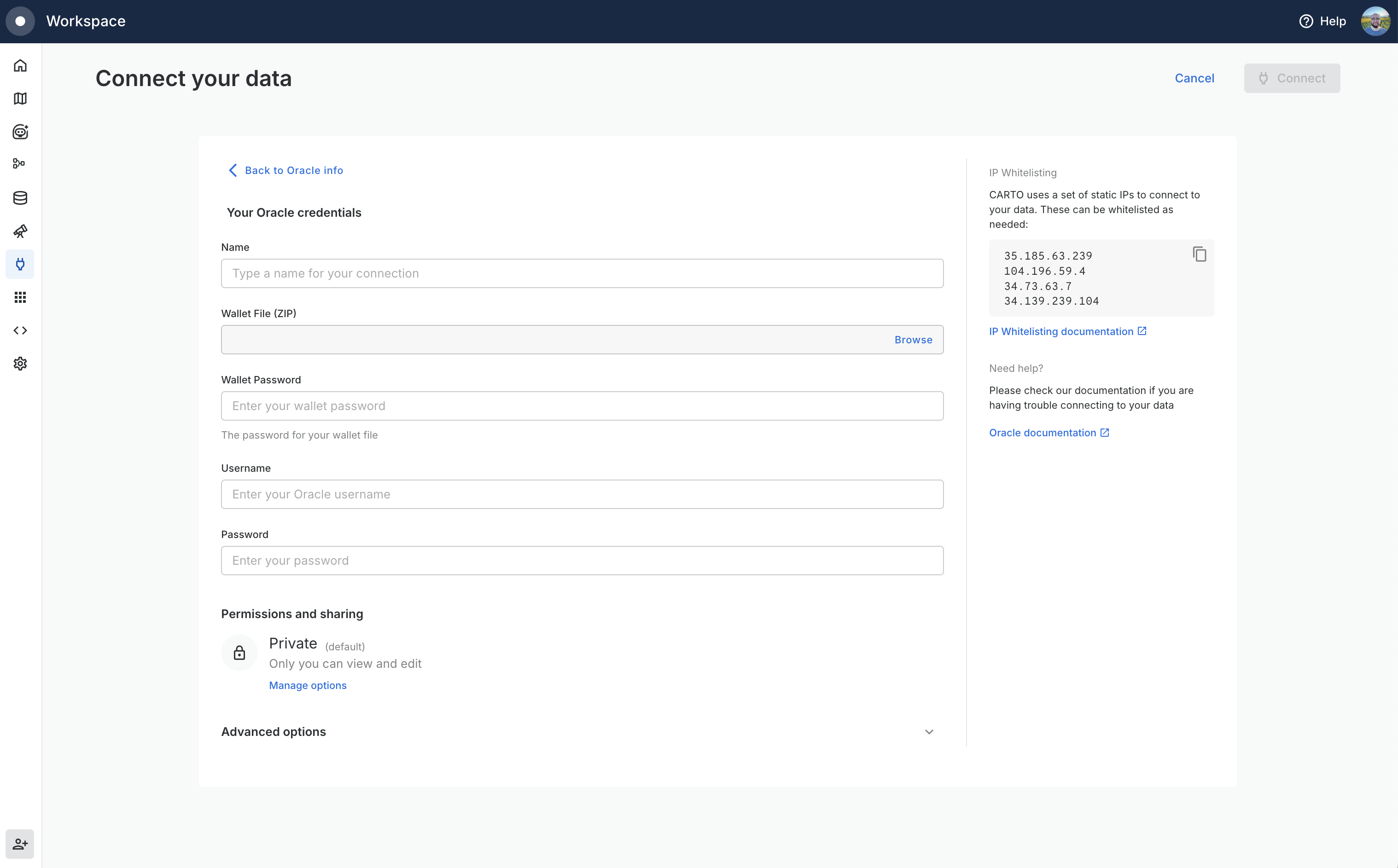
To establish a connection, you need to provide the following:
* **Name:** The name for the Oracle connection you're creating. You can use the name to identify different connections.
* **Wallet File (ZIP)**: Upload your Oracle Wallet file containing the security credentials and certificates. This file is typically provided by your Oracle database administrator.
* **Wallet Password**: The password protecting your Oracle Wallet file.
* **Username**: Name of the user account that will access the Oracle database.
* **Password**: Password for the user account.
{% hint style="info" %}
**About Oracle Wallet**
Oracle Wallet files are ZIP archives containing security credentials. Your database administrator can provide this wallet file along with the connection string and wallet password. For Oracle Autonomous Database, you can download the wallet file from the Oracle Cloud Console.
{% endhint %}
Once you have entered all the parameters, you can click the *Connect* button. CARTO will try to connect to your Oracle database using the wallet credentials. If everything is OK, your new connection will be registered.
{% hint style="info" %}
CARTO will try to minimize and reuse the number of connections (sockets) made to the Oracle database. But in some cases the amount of connections can grow rapidly. If you have a strong requirement to control the incoming connections to your database, we recommend configuring connection pooling on your Oracle database.
The connections are only reused if they are going through the same CARTO-Oracle Connection. If you set up many Connections in your organization, the amount of database connections will grow faster.
{% endhint %}
### Advanced options
{% hint style="info" %}
**Note:** Self-service Data Observatory locations are not configurable from the connection form. Data Observatory subscriptions are delivered to Oracle through a request-based transfer — see [Access data in Oracle](/carto-user-manual/data-observatory/accessing-your-subscriptions-from-your-data-warehouse/access-data-in-oracle.md).
{% endhint %}
* **CARTO temp location**
Location to store **temporary tables** used during workflow execution. These include intermediate tables with hashed names created by nodes in a workflow. By default, CARTO uses a `carto_temp` schema per database.\
**Example:** `my_oracle_db.carto_temp`
## IP Whitelisting
If you're using CARTO Cloud, CARTO will connect to Oracle using a set of static IPs for each region. [Check this guide to find the IPs you need to allow](/carto-user-manual/connections/ip-whitelisting.md) for your specific region.
## Supported Features
{% hint style="success" %}
**Oracle Spatial & GeoRaster Support**
Oracle connections fully support:
* **Oracle Spatial (SDO\_GEOMETRY)**: Native support for Oracle's spatial data type, including point, line, and polygon geometries
* **GeoRaster**: Support for raster data analysis with dedicated workflow components
* **Data Import & Export**: Import files into Oracle and export data out of Oracle from Data Explorer, Builder and Workflows — see the [supported import](/carto-user-manual/data-explorer/importing-data.md#supported-formats) and [export](/carto-user-manual/maps/exporting-data.md) formats
* **Data Observatory**: Deliver Data Observatory subscriptions to your Oracle database through a request-based transfer — see [Access data in Oracle](/carto-user-manual/data-observatory/accessing-your-subscriptions-from-your-data-warehouse/access-data-in-oracle.md)
* **Self-Hosted Deployments**: Available in both CARTO Cloud and Self-Hosted environments
{% endhint %}
## Browsing your Oracle data
When you browse an Oracle connection — in Data Explorer, when adding a source in Builder or Workflows, or in the Import dialog — CARTO hides Oracle's internal tables to keep listings clean. Oracle automatically creates auxiliary tables for some of its features, and all of them contain a `$` character in their name:
* `MDRT_…$`, `MDXT_…$`, `MDRS_…$` — Oracle Spatial index (R-tree) tables
* `DR$…$I`, `DR$…$K`, `DR$…$N`, `DR$…$R` — Oracle Text index tables
* `MLOG$_…` — materialized view logs
{% hint style="warning" %}
Any table or view whose name contains `$` is treated as an internal Oracle object: it won't appear when browsing a schema or in search results. If you own tables with `$` in their name, we recommend renaming them. They remain fully accessible by their qualified name (`schema.table`) in SQL queries and other direct references — they just won't be listed.
{% endhint %}
## Analytics Toolbox & Workflows
{% hint style="info" %}
* **Analytics Toolbox:** The [Analytics Toolbox for Oracle](/data-and-analysis/analytics-toolbox-for-oracle.md) provides data enrichment and the H3 and Quadbin spatial-indexing modules. See the [Analytics Toolbox for Oracle SQL reference](/data-and-analysis/analytics-toolbox-for-oracle/sql-reference.md) for the complete list of available functions.
* **Workflows:** Oracle supports most standard workflow components including spatial operations (buffer, intersection, centroid, etc.), data operations (select, join, filter, etc.), and Oracle-specific components (geocoding, raster loading and analysis). See the [Workflows Components documentation](/carto-user-manual/workflows/components.md) for the complete list.
{% endhint %}
---
# Agent Instructions
This documentation is published with GitBook. GitBook is the documentation platform designed so that both humans and AI agents can read, navigate, and reason over technical content effectively. Learn more at gitbook.com.
## Querying This Documentation
If you need additional information that is not directly available in this page, you can query the documentation by asking a question.
Perform an HTTP GET request on the following URL with the `ask` and `goal` query parameters:
```
GET https://docs.carto.com/carto-user-manual/connections/oracle.md?ask=&goal=
```
`ask` is the immediate question: it should be specific, self-contained, and written in natural language.
`goal` is what the user is ultimately trying to achieve, the reason they need the answer. Sharing it helps GitBook give you a better, more relevant answer. A goal is most helpful when it describes the outcome the user wants rather than restating the question. For example, with `ask=how do I create an API token`, a goal like `automate deployments from our CI pipeline` lets GitBook tailor the answer to that use case.
The response will contain a direct answer to the question and relevant excerpts and sources from the documentation.
Use this mechanism when the answer is not explicitly present in the current page, you need clarification or additional context, or you want to retrieve related documentation sections.